

Goal
Game studios spend weeks on the player characters in their games. They take their time to create a character that feels good and is immersive for the player to control. They do this because if the player controller does not feel good the game will not be nice to play. The player controller is one of the most important parts of every game. That’s why my goal will be to create my own player controller that feels nice and immersive to use. To make it more interesting I want to create this player controller for a character that can fly, an eagle. I want to create flying player movement because I have had the idea of it for some time but never new how and had never context to create it.
Scope
My goal is to create an eagle character with an immersive feeling player controller. I am not an modeler/artist/animator, so for the models and animations I want to use I will be using whatever I can find on the internet and only create new thinks when I cannot find something good enough. What I will be creating entirely from scratch will be the movement, to do this I will research the movement of real birds. At first I will create some flying states but later I hope to add extra states like diving and landing.
To reach my goal I need to make sure the controller feels good to use for the player. To make something nice to use means it feels immersive, you are focused on the character without trying, sucked into it, able to control the character without thinking about it. This is hard metric to measure, but I will be AB testing different version of controllers to find out which one feels better. I will also research tricks that improve immersion.
Content
- Immersion
- Real-time control
- Simulated space
- Polish
- Movement
- Flying
- Flying States
- Hovering
- Flying
- Gliding
- Steering
- Pitch
- Roll
- Yaw
- Controller
- Testing
- Results
- Testing
- Polish
- Testing
- Results
- Testing
Immersion
To create something immersive it is important to define immersion and know how to make something immersive. Immersion is a word that describes the feeling a player has when he is totally focused and sucked into a game. The goal of most games is to create immersion so the player wants to play the game and keep playing. In his book Game Feel (2008) Swink explains the three factors that can make or break immersion in a game. These factors are real-time control, simulated space and polish.
Real-time control
When a player is playing a game the player is communicating with a computer. The player talks with the computer with the input he gives through the keyboard for example. The computer talks back by showing the results on the screen. When the computer shows the results of the player input directly the player has real-time control over the game. Having real-time control over the game is one of the factors that can improve the feel of the game and creates immersion.
A computer can never show the something directly, because the computer has to take the input, calculate the results and put it on the screen. This cost time. In games the time between input and a result on the screen is expressed in ms, which stand for millisecond, a thousands of a second. This time is influenced by the time it takes the computer to calculate everything, so having optimized code and a better computer improves this time. In a multiplayer game communicating with the server also costs time which influences the feeling of real-time control. If the time between input and result on the screen is bigger then 240 ms the feeling of real-time control is lost. But over a longer period of time a slow reaction time will be noticable and break the feeling, so over a longer time the reaction time should be consistently 100 ms or faster. If the reaction time is 50 ms it will feel as instant for the player, real-time control.

If a computer changes something on it’s screen it needs to refresh the entire screen, it does this multiple times each second. The rate at which the screen is refreshing is expressed in fps, frames per second. When the computer does this slow it becomes noticable, most games run at least 30 or 60 fps. At 30 fps a game looks smooth. At 60 fps or higher it is almost unnoticable that the screen is refreshing. When the player is controlling something it adds immersion when it looks like this object has motion on the screen. To create motion the object should change at least at 10 fps, otherwise the feeling of motion will break. At 30 it will feel smooth, and higher is always better.
Real-time control also contains control. The player only feels like it is controlling the game when the result shown on the screen is what the player expected with the input given. If the game does something the player was not trying to tell it to do the player does not feel like it is controlling the game. The feeling of immersion will break, even if the computer is reaction in real-time.
Simulated space
A game is a digital space with bounderies in which a player can interact. The space and everything in it is a simulation. This simulated space are all the objects in a game and the interaction between them, including the player character. If a player understands and expects everything that is going in the simulated space, and what is simulated it improves immersion. That’s why the simulated space is one of the factors of game feel. If a player has no idea what is going on it is hard to immerse into the game. It gives context to the thing that real-time controlled.
To help the player understand and expect things making things realistic can help. If object look like the thing they represent it is easy for the player to understand what it is, and to expect what it will do. When something represents a real-world thing a player will expect that it will behave in a realistic way, with realistic physics. Simulated physics do not have to be realistic but they must be consistent so the player can learn what to expect.
Creating a goal for the player also gives context to the real-time controls. In a game this means that there is a goal to advance in the game or even complete it, so the player has something to work to. To get to this goal the player needs to use the real-time controls. When a player is controlling something to reach a goal a flow can arises where the challenge is in reach of the players ability, but still challenging enough so it is not boring. If a player is in this flow the engagement and immersion of the player is high.
Polish
A player controlled character that interacts with a simulated space is nice and can be immersive, but polishing those interactions takes the game to another level. Polish empasizes the impact of the players interaction. The feeling of an explosing is more impactful when a screenshake, sound, animation and particles are added. Polish makes the simulated space more appealing for the player and makes it more immersive. That is why polish is one of the factors of immersion.
Movement
To create a bird movement has to be created to add to the bird. Realistic physics and movement improve the immersion of the simulated space. This means it is usefull to know how real-world birds fly so a realistic simulation can be made.
Flying
Birds are a special animals, because they can fly. Flying is something that is not possible for humans and most animals because gravity keeps them on the ground. But birds have defeated gravity. Every bird has special features like an aerodynamic shape and low body weight. But the most important part of every bird are it’s wings. That’s why airplanes have wings modelled after the wings of birds.
Wings have a special shape, which is called aerofoil, that has a lot of influence on the air that passes. Because a lot of air wants to go over the wing the air is pushed together and starts moving faster. Because the air moves faster on the top of the wing compared to the bottom side a the air pressure on top is lower, This is because of the Bernoulli effect. Because of the low air pressure the air on the bottom side pushes the wing more upwards then the air on the top side pushes the wing down. Another effect that happens on the wings is that the air follows the shape of the wing, redirecting the air more downwards, this is caused by the Coanda effect. Because the air and it’s momemtum is redirected downwards the wing gains upwards momentum.
Airplanes and birds can control the angle of the wing, and so changing the angle at which the wind hits the wing. This angle is called Angle of Attack, or AOA. With a greater AOA more air is directed downwards, creating more lift. But the drag on the wing increases.
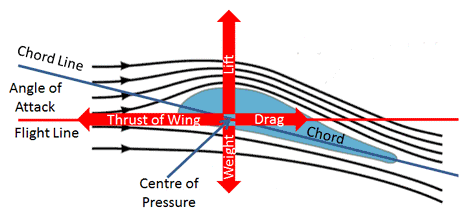
Flying States
The wings of birds make them able to fly, but they use them differently for different purposses. These different usages are dividable in three states. These states are hovering, flying and gliding.
Hovering
When a bird is in the state called hovering it flaps it wings to create lift, without creating thrust forward. This means that the bird has the same lift as gravity and stays still in place. The gravity force on the bird can be calculated with Fz = m * g. Where m is the mass of the bird is and g the acceleration created by gravity. g can be calculated with dv/dt, the change in velocity per second. By flapping their wings the bird gives a downward force to the air. By the conservation of momentum the bird gets the same momentum upwards, called lift. Because the bird stays in it’s place when hovering the force the air gets is the same as gravity creating the same lift force as gravity. This force is calculated with lift = m/dt * dv. Where m/dt is the airflow, the mass of air pushed down per second, and dv the change in velocity.
Flying
Staying in place is nice, but often a bird wants to go somewhere. This can be done in the flying state, where a bird gains speed and altitude. To do this a bird flaps it’s wings to create thrust. This thrust is a force upwards and forwards, this force is created by pushing are downwards and backwards. This force is calculated with thrust = m/dt * dv. Where m/dt is the airflow, the mass of air pushed down per second, and dv the change in velocity.
How this thrust is divided between lift and a forward force is determined by the AOA of the wings. Birds can control this AOA. The lift can be calculated with thurst * sin(Yo). Yo can be calculated with Yo = 90o – AOA. The forwarding force can be calculated by subtracting the lift from the thrust.
Gliding
Another way of moving forward is gliding. When a bird is gliding it does not need to waste energy flapping it wings, it just uses the lift generated by the shape of the wings while losing altitude to gain more speed. This lift generated can again be calculated with lift = m/dt * dv. Where m/dt is the airflow, the mass of air pushed down per second, and dv the change in velocity. How much altitude the bird loses is controlled by the AOA of the wings, which is negative while gliding.
Some birds can gain a lot of speed while gliding, while losing little altitude. In some circumstances, like head wind, birds can even gain altitude while gliding. This is called soaring and is caused by the greater amounts of air flowing passed the wings and allows the bird to have a positive AOA without needing to flap for lift.


Steering
Birds cannot only move up, down and forward, but also left and right. They do this by steering on all three axes, in contrast to a car for example, that can only move along two axes. Movement on the axes are called pitch, roll and yaw. These type of steering is simular to how an airplane steers, but also other things or animals that move over three axes, like submarines and fish.
Pitch
Controlling the pitch means that the nose of the bird or airplane will go up or down. Airplanes do this with flaps on their wings, birds can just change the AOA of their wings.
Yaw
Controlling the yaw means that the bird will go left or right. Birds can do this with there wingtips. They can twist the tip of their wings to steer left or right.
Roll
Controlling the roll means that the body will move in a circle, clockwise or anti-clockwise. One of the wings will be higher than the other one. Birds can do this with there wingtips, by doing this one of the wings will create more lift than the other one.

Controller
It is nice that the bird has movement, but that movement is useless when it cannot be controlled by the player. To let the player control the movement of the bird a controller has to be added. The controller of a game is all the inputs a player can give to control the movement of a character combined.
The quality of the controller determines the real-time control feeling of the game. A part of this just means that it should run smoothly without delay, but the intuitiveness of the controller can be created. The controller feels intuitive when the player feels it is in control of the player character. This can be done by making the controller easier to use and the movement consistent and predictable.
The camera is also an important part of the controller, because when the player character is not being shown properly on the screen the feeling of being in control can be lost. So the camera should automaticly follow the player character in some form or should be controllable by the player.
Creating a controller that feels intuitive for something that flies can be hard, because the player character has a lot of different movement and directions it can move to. If the controller is to complicated the player might lose the feeling of being in control. A solution is controlling multiple moves with one input or automate moves and switching between states. Combining to many moves takes away the control of the player, which results in losing the feeling of being in control. To find the perfect balance between this multiple controllers should be tested and compared to find the one most optimal, giving the player the best feeling and bringing immersion.
Different controllers will use different inputs or even different input devices. To make a fair comparising only controllers using mouse and keyboard will be created and compared. This means input devices with thinks like joysticks. To create these different controllers other games can be used as reference to see which keys are often used. Consistency with other games will help improve the intuitiveness of the controller.

Testing
If a player feels like being in control of a character the controlling becomes immersive. To find a controller that creates the feeling of being in control we can compare multiple versions and test them to find the best one. To compare multiple versions there can be made use of AB testing. This means that two versions will be compared directly to eachother to find the best one. Because it is usefull to know what it is that makes the controller better more information is needed then only pointing out the best one. In preperation of these tests a testplan needs to be written so the test will be done in the right way.
Results
After testing with multiple testers a conclusion can be drawn. One version is clearly the better one because the testers felt more in control and find the controlling more interesting. This is the version where the direction of the bird is controlled by the mouse and the camera follows the bird. The controlling with the mouse was called uniq but satisfying, free but in control. The way the test was done had the benefit of allowing more feedback point being given. So were some weird things with the movement pointed out, but also things with the camera.
Polish
With a enviroment, a model and movement we have simulated space. With a controller to control the movement of this model we have real-time control. To create full immersion we also need polish. Polish helps convey the emotions to the player. When something has impact it needs to feel like it has impact to the player, polishing that can be added to convey this is screenshake for example.
Creating a feeling will improve immersion, so we need to decide what feeling we want to create and how to create this. The feeling that needs to be created is the feeling of flying, moving through the air and wind. So we need to add stuff that will create the feeling of moving trough wind, stuff like sound can add this feeling. Another feeling that can be created is the feeling of speed. Because without polish it does not feel like the bird is moving fast. While performing the previous tests it also turned out the testers had no idea how fast they where moving. So the feeling of speed can be created with polish, with tricks like changing the field of view of the camera and adding blur.
Testing
For the research it is important that it is tested if the polishing tricks have the effect that is expected. The immersion needs to be tested. To do this we can test a version with and without the polishing with testers and let them rate versions both on a Likert scale to see if there is a significant difference created by the polishing. Before performing these test a test plan needs to be written as preperation for these tests.
Results
After testing it is clear the polishing added has effect on both immersion and feeling of speed. The testers gave the version without polish a 2.4 out of 5 on average, and the version with polish a 3.6 out of 5. The feeling of speed also improved. In the version without polish the testers guessed their top speed at 127.4 km/h on average and in the version with polish this was 172.8 km/h. These results should be a taken with a little grain of salt because the testers knew they were tested and that they saw one version with extra effects. The speed question also had no bounderies so all numbers could be entered without reference. The number also is not corrected for extremes. But these tests show that the polishing achieves its goal.
Bibliography
A short hike on steam. (n.d.). https://store.steampowered.com/app/1055540/A_Short_Hike/
Birdfact. (2022, July 5). How do birds fly? (In-Depth Guide). Birdfact. https://birdfact.com/articles/how-do-birds-fly
Chinta, R. (2017). Measurement of Game Immersion through Subjective Approach [Masterscriptie]. Blekinge Institute of Technology.
Chronister, N. (n.d.). Bird flight. Copyright 2004, Nathan Chronister. https://www.ornithopter.org/birdflight/flap.shtml
Feather on steam. (n.d.). https://store.steampowered.com/app/545040/Feather/
Gameflare.com. (2013, July 22). Fly Like a bird 3 – Online Game. https://www.gameflare.com/online-game/fly-like-a-bird-3/
Hamilton, T. (2023, October 7). TEST PLAN: What is, How to Create (with Example). Guru99. https://www.guru99.com/what-everybody-ought-to-know-about-test-planing.html
Hirzel, A. H. (n.d.). Bird flight. https://www2.unil.ch/biomapper/opengl/BirdFlight.html#:~:text=The%20angle%20of%20attack%20is,of%20drag%20which%20quickly%20increases.
Landell-Mills, N. (2019). How birds fly according to Newtonian physics. ResearchGate. https://www.researchgate.net/publication/336265186_How_birds_fly_according_to_Newtonian_physics#:~:text=According%20to%20Newtonian%20mechanics%2C%20a,similar%20to%20how%20insects%20fly.
LibKey. (n.d.). https://libkey.io/libraries/588/openurl
MuYe. (2021, November 24). Why racing games feel slow [Video]. YouTube. https://www.youtube.com/watch?v=e9OriySqLjQ
R. Warrick, D., W. Tobalske, B., & R. Powers, D. (2005). Aerodynamics of the Hovering Hummingbird [Faculty publication]. George Fox University.
Rajesh, V. (2022, January 6). Breaking down bird flight – predict – medium. Medium. https://medium.com/predict/breaking-down-bird-flight-b794ed45e077
Regis, E. (2020). No one can explain why planes stay in the air. Scientific American. https://doi.org/10.1038/scientificamerican0220-44
Rewired Documentation | Player Controllers. (n.d.). https://guavaman.com/projects/rewired/docs/PlayerControllers.html#:~:text=Player%20Mouse-,Overview,interface%20for%20a%20Rewired%20Player.
Sattar, M. (2022, August 3). Best Games For Bird Lovers. Game Rant. https://gamerant.com/best-games-bird-lovers/
Sixty Symbols. (2017, September 11). Lift and Wings – Sixty Symbols [Video]. YouTube. https://www.youtube.com/watch?v=PF22LM8AbII
Steve Johnson. (2014, November 30). Eagle hovering [Video]. YouTube. https://www.youtube.com/watch?v=YHNo5e4bdlg
Swink, S. (2008). Game Feel: A game designer’s guide to virtual sensation. https://openlibrary.org/books/OL17075228M/Game_feel
The lift coefficient. (n.d.). https://www.grc.nasa.gov/WWW/K-12/FoilSim/Manual/fsim0007.htm#:~:text=To%20summarize%3A-,Lift%20%3D%20Cl%20x%20dynamic%20pressure%20x%20area,x%20density%20x%20velocity%20squared
The lift equation. (n.d.). https://www.grc.nasa.gov/www/k-12/rocket/lifteq.html#:~:text=The%20lift%20equation%20states%20that,times%20the%20wing%20area%20A.&text=For%20given%20air%20conditions%2C%20shape,Cl%20to%20determine%20the%20lift.
Thielicke, W. (2014). The flapping flight of birds [Thesis]. University of Groningen.
University of Silicon Valley. (2021, May 15). How to make Immersive game Design | University of Silicon Valley. https://usv.edu/blog/how-to-make-immersive-game-design/
Veritasium. (2012, August 3). How Does A Wing Actually Work? [Video]. YouTube. https://www.youtube.com/watch?v=aFO4PBolwFg
Wirtz, B. (2023, July 4). Game Design with Impact: The Psychology of Video Game Immersion (Bonus: List of the Most Immersive Games). Video Game Design and Development. https://www.gamedesigning.org/learn/game-immersion/
