

Table of contents:
- Introduction
- Storytelling Techniques
- Level Design
- Mechanics
- Environment
- Events
- Obstacles
- Environmental storytelling
- Static objects and Animations
- Color
- Lighting and Post Processing
- Level Design
- Script
- Implementation
- Level Design
- Mechanics
- Environment
- Events
- Obstacles
- Environmental storytelling
- Static objects and Animations
- Color and Lighting
- Post Processing
- Level Design
- Testing the scene
- Information to gather
- Preparations
- Expectations
- Tests
- Overall Results
- Second iteration
- Preparations
- New Research
- The player character
- Audio
- Implementation
- The player character
- Audio
- The Trees, Grass, and Path
- Set piece
- Mechanics
- Other small changes
- Result
- Second test
- Tests
- Overall Results
- Difference
- Conclusion
- Sources
1. Introduction
Within most of the story games that are released now adays, there is some sort of text with them. This is either done through the cutscenes with dialogue, journal pages spread around the world, writings on walls or anything other story related. So, I started to wonder how much of these texts, were deemed necessary. Would it even be possible to create a story game without the usage of any text? As somebody with Dyslexia and the goal to create stories for games, it would be an invention to figure out if some story elements can replace text. I faced a lot of barriers when working on heavy dialogue stories because of my Dyslexia, so the result of the research should help with the creation of stories in the future.
After some research I did find some games who have now dialogue whatsoever and I was amazed by how much they can clarify to a player with the usage of visuals and sound alone. When looking at Journey for example, the developers where able to guide the player and keep them engaged all while telling a story and conveying emotions.

Figure 1, Journey (2020).
So, Dyslexia and the interest in bringing stories into the core of games are the reasons to why I decided to take a deeper look at how I could make a story game without dialogue.
2. Storytelling Techniques
When looking around for what kind of techniques I could research, I stumbled upon a video of the Game Maker’s Toolkit (2020). He named an interesting structure in which three components need to work toghether to create a great story within games. These are the following:
- Level Design
- Environmental storytelling
- World building
The world building is all about the characters and world setting (Game Maker’s Toolkit, 2020). Since this is mainly defined within the script and due to a lack of time, I decided to focus on the Level Design and Environmental storytelling instead. I decided to research them more into depth and see what I could apply to my own game. Below, each component will be discussed.
Level Design
Level Design is the creation of levels within games. A level consists of the following components:
- Mechanics
- Environment
- Events
- Obstacles
(Collins, 2023)
Toghether, they aim to create a positive experience for the player and, when integrated with it, tell a story. Each of these components will be discussed and how to integrate the story within them.
Mechanics
Mechanics are the rules and systems that decided how a game works (Brazie, 2023). Such as walking, climbing, shooting, etc. A mechanic has consequence on how the game is being experienced.
Based on a video of the GDC (2017) the mechanics can be used to help tell a story. By taking the Plot and Events of the narrative, it’s possible to translate them into mechanics that are needed to tell the story. The Plot and Events is the “What?” question. What is the story about? What is the goal? What are the things that happen on the way to the goal?
By implementing this theory, the mechanics becomes a means by which the player can experience the story. It’s important though to keep in mind that the mechanics are also widely dependent on the genre of the game. So, to create the right mechanics we need to look at the story as well as the genre.
Example
Let’s look at an existing game to test this theory.

Figure 2, Hogwarts Legacy (2023)
Looking at the narrative, it’s all about you becoming a full-fledged wizard or witch while uncovering a source of unknown power that lies within you. Furthermore, the genre for this game is action role-play (Hogwarts Legacy, 2023).
Based on the theory, this should be the case:
| Plot and Events | Mechanics |
| Uncover the unknown power within you, while becoming a full-fledged wizard or witch. | Spell casting (or other actions that include to you becoming a wizard or witch) to defeat enemies and the usage of this unknown power in some way. |
And this is the case. When looking the game mechanics of Hogwarts Legacy, you can do a lot of different things that has to do something with you becoming a sorcerer. These things contain, flying, casting spells to either fight enemies or solve puzzles (this also includes the usage of the unknown power), and brewing potions. All these mechanics create a cohesion between the story and the gameplay.


Figure 3, Hogwarts Legacy (2023)
Environment
When designing environment, there are two things to look at: play space and theme. Play space is the physical location where the player acts or performs, while the theme is the overall idea (for example, medieval times where you need to save the princess) (Devstree, 2023).
Play space
When integration narrative into play space, it’s important to ask the “Where?” question (GDC, 2017). It wouldn’t make sense story wise to have a spaceship themed play space when the answer on the where question is a farm. Take the following game as an example:

Figure 4, Hollow Knight (2017)
Hollow Knight’s story is all about exploring an underground kingdom and finding its secrets. So, the play space is designed towards this. If the play space would have been designed for anything else the story wouldn’t make sense and therefor lose its purpose.
Theme
Integrating narration into the theme is done by the usage of the “How?” question (GDC, 2017). How will the story be told? Does it need to have a lot of suspense or action? When the theme is determined, other components of the game can derive their decisions from the theme. Such as the type of assets that can be used, point of view form which it needs to be played and the overall mood and style the game needs to have. This is especially important for later, when we look at how (and which) emotions can be brought into the environment (see the chapter Environmental storytelling).
Events
Events within this context, are better known as set pieces. Set pieces help immerse the player into the environment by providing an interactive game environment (Galuzin, 2016). Also known as things that happen within the game’s environment. This can be done either with direct or indirect actions from the player.
Set pieces are used to create powerful moments that last with a player (Kelly, z.d.). So, set pieces are perfect to help emphasize the narrative on specific moments.
Example
Within Tomb Raider there are multiple parts in which you must climb. In this example, it’s an old airplane.

Figure 5, Tomb Raider (2013)
The narrative in this part of the game, is about Lara Croft (the player character) who is wounded and searching for a save place.
When climbing, suddenly a part of the airplane falls, and your character loses its footing.
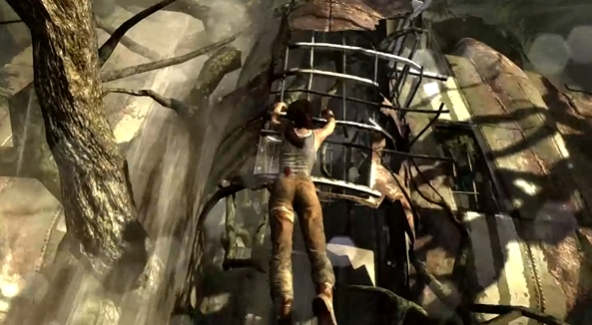
Figure 6, Tomb Raider (2013)
This is a perfect example of set piece that helps with telling the narrative. It created the suspense the narrative wants you to know Lara Croft is feeling, without the usage of having to tell the player that with any words.
Obstacles
Obstacles are oppositions the player must overcome. This can range between battles, puzzles, exploration, etc. (Galuzin, 2016). The type of obstacle is dependable on the genre (a puzzle game has puzzles, an RPG has enemies, etc.)
When a puzzle has coherence with the events in the story, the puzzle is considered a narrative puzzle (Wei & Durango, 2019). Integrating something like a narrative puzzle into a story game, gives the player the opportunity to experience the story while solving them.
To create a narrative puzzle, it’s important that the objects and characters create the challenge. (Wei & Durango, 2019) When doing so, it makes sense that the puzzle is there and why it should be fixed. It doesn’t become something to fill time, it becomes something that has an impact on characters and players or on the learnings on the fictional world.
This is highly specific for puzzles, but any other kind of obstacle needs to have the same components to fit in with the story. Searching for a key when you’re walking out and about or fighting with magic when this should not exist in the world, conflict with the story and therefore doesn’t make sense inside of the game.
Example
The following game does the integration in obstacles very well:

Figure 7, Storyteller (2023)
Storyteller is all about the player creating the story. The only thing the game tells you is the outcome of the story, everything else is determined based on how you solved the puzzle. The developers of Storyteller integrated the puzzle in such a way it became a part of the story, instead of using the puzzle (the obstacle) only for the gameplay.
Environmental storytelling
Environmental storytelling is the use of the game space, to enhance the narrative (Zakowski, 2016). To do this, it focuses on the theme, tone, and mood of the narrative and looks for ways to implement this into the game (Rouse, 2010). There are multiple components that can be used to do this, such as:
- Static Objects, Animations, Overheard conversations, and text (Game Maker’s Toolkit, 2020)
- Color (Andersen, 2019)
- Lighting and Post Processing (Andersen, 2019)
Since I’m trying to create a game without text or dialogue, I won’t go into depth about the Overheard conversations and text components. All the other components are discussed below.
Static objects and Animations
When we talk about the usage of Static objects and Animations to create environmental storytelling, we talk about the usage of set dressing to create small, optional, and self-contained vignettes (Game Maker’s Toolkit, 2020). This can be done with text or with the positioning of objects in the play space. When using this technique, it makes the player and participants to in the storytelling process, since they need to connect the dots themselves.
Usage
One of the most successful methods of using these vignettes, are by the usage of “cause and effect’’ (Carson, 2000). The question of why something is there and how it came to be. This can help a player understand where they are and what they might expect, how much time has passed and help with the actual gameplay.
The Game Maker’s Toolkit (2020) gave an excellent example, from Uncharted in which there is a piano in the kitchen, covered in moss.

Figure 8, Uncharted (2020)
A few minutes later, the player finds themselves in a music room, with a gap in the floor, and the piano right below it.

Figure 9, Uncharted (2020)
This suggests a story on itself. It gives reason to why a piano is in the kitchen and how it came to be. I also suggest a passage of time which can help with understanding the environment.
Color
Color is a great tool to help emphasize feelings and to help guide the player experience (Kauranen, 2023). It has a set of rules that can be used for impactful effects. It’s a broad concept, big enough to have its own research, so only a very small part will be discussed here.
Emotions
When looking at certain colors, we tie certain emotions to them. Such as pink that should make people less aggressive. This can be very subjective, since players can also bind a certain hue or shade to a certain environment and therefore changing the way they feel about it. The players origin and current location can also affect the way they feel about a color (Kauranen, 2023). For example, red in the western cultures are associated with danger, while in the eastern cultures it is used for prosperity.
Usage
Kauranen (2023) gives an example of a church painted with slightly different colors.

Figure 10, Kauranen (2023)
Every version gives a different emotion, even though it’s the same church. This clarifies how important it is to think about what we want to tell the players and which emotions are tied to them. This in combination with lighting, can create powerful moments and set the tone the game wants to deliver.
Lighting and Post Processing
Lighting
Lighting is mainly used to draw the attention of the player (Vredenberg, 2017). There are different types of lighting that can be used.
- Ambient light: The overall lighting in the level.
- Directional light: Light that simulates sunlight.
- Spotlight: Light that is cast from a certain angle and direction. Usually used to guide a player towards a specific direction.
- Point/Omni light: Light that is cast from a single point. Usually used to focus the attention of a player, without being as intense as a spotlight.
(Pérez Andreu, 2019)

Figure 11, Pérez Andreu, (2019)
Post Processing
Post Processing is also known as image effects and is used to change the looks of a game (Brackeys, 2020b). It is often used a last touch in the game development process, but it can also be used to change the style of the game completely.
There are a lot of different types of post processing, but they can be categorized into four categories:
- Color Correction: Effects that change the colors.
- Lens effects: Effects that change the lens of the camera. This is used to change how the player sees the game. Things like depth of field and motion blur, fit inside of the category.
- Camera effects: Effects that help smoothen out surfaces. This can be applied to objects to get rid of rigged lines or help smooth color when there is a change of brightness.
- General effects: Effects that change the scene and the way the player sees the world. This can range between making areas appear lighter or changing the darkness of the edges of the game view.
(Brackeys, 2020b)
Usage
With the usage of lighting, it’s possible to create an overall mood (especially when combined with color) and to draw the attention of the player towards specific objects or areas. This will help with guiding the player and setting an overall tone. Take the previous image form Uncharted for example:

Figure 12, Uncharted (2020)
By shedding only light on the piano, the player is attracted towards it.
Post processing can change the look of a game completely. Therefor it will help greatly with setting the mood of the game. Here is an example of what it can do:
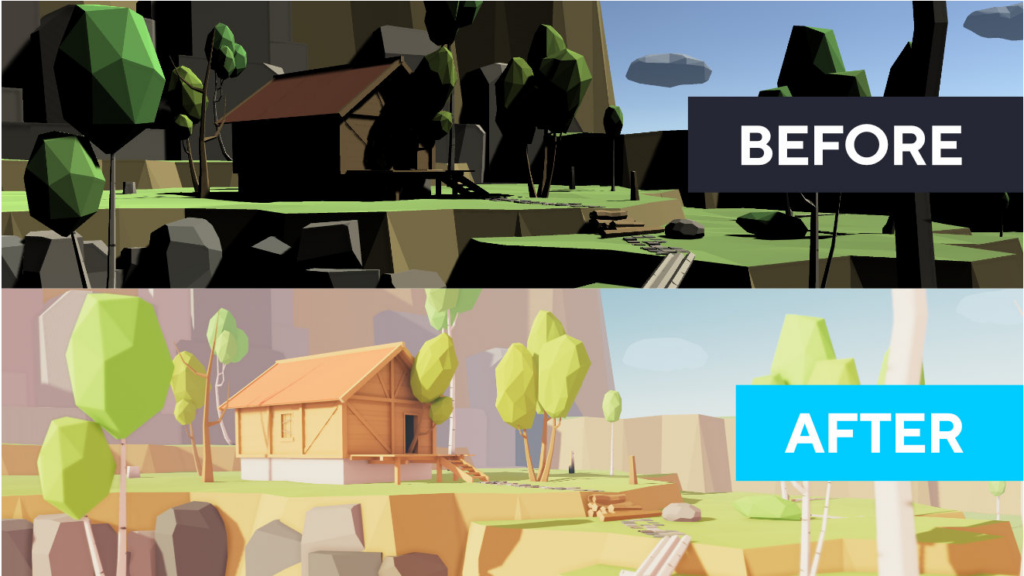
Figure 13, LMHPOLY (2020)
For both techniques it’s important to know beforehand what the overall mood of the game will be.
3. Script
To implement this research a story is needed. Instead of taking an existing story, I decided to write my own. Especially for specific scenes with a game, a story needs to be written in the shape of a script. Based on an article of SpaceDraft (2022) and Murisier (2022), the following is needed to create a game script:
- A plot/Concept (What will the story be about?)
- Outline (First the script or first game design?)
- Worldbuilding/Setting
- Characters (Who are the characters? What is their history?)
- Story flowchart (In which order happens what?)
- Side stories/side quests (If applicable)
- Review by peers
After all these steps are done, the actual script can be written.
In the document below, the result of these steps can be found.
There is just one more thing to look at. A script without dialogue. This is needed because the game will also not have any kind of dialogue. Based on an article form Wilson (2022) a script without dialogue should be written action based. Furthermore, it’s important to visualize locations, describe characters distinctively and that no dialogue doesn’t mean no sound.
For this research only the script of level one is written. This can be found below, within the document.
4. Implementation
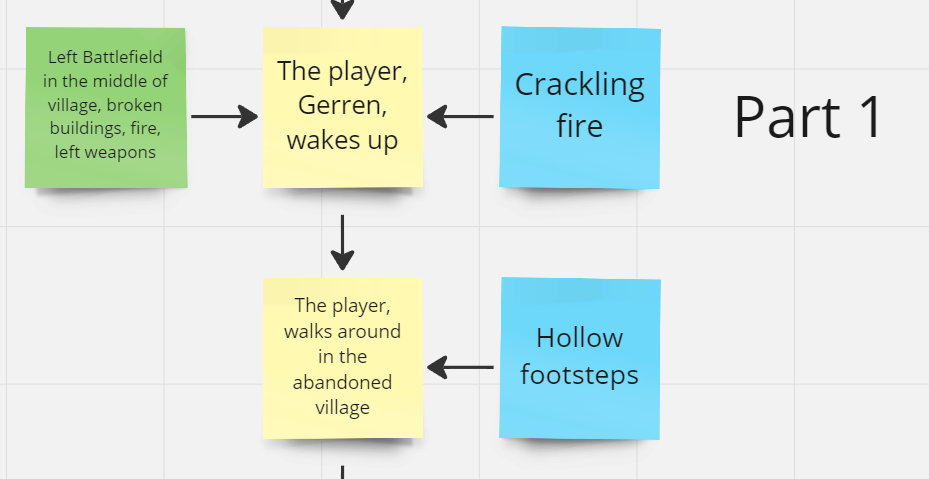
As seen within the story flowchart, the first level consists of three different phases. To see how the research should be implemented, I decided to first create the first phase of the game completely. When this is done, and the when the feedback is implemented, I could always create the rest of the first level. Some things that I will make, will be used for the whole first level. When this is the case, it will be mentioned when creating phase 2 and 3.
This is everything phase one needs to include:
Level Design
Mechanics
As mentioned in the Storytelling Techniques chapter, to determine which kinds of mechanics to use I need to answer the “What?” question. This is answered through the story (see Script chapter). Aside from the answer to this question, the genre is also needed to determine the mechanics.
These are the results:
| Plot and Events | Genre | Mechanics |
| Searching for home and purpose inside of the world. | Adventure (games that focus on strong storytelling and visual aesthetics (Adams, 2014)). | Walking, jumping, sprinting, looking around. Interaction with objects and environment. |
Now that it’s clear what the mechanics should be, it’s time to implement them within the project. Whit the help from form Code Monkey (2021), I was able to add easily customizable player movement and interaction:
The movement is done with the usage of the WASD keys and the mouse input.
Interaction is done with the E key. When the interaction is executed, “hit” is shown in the consol.
All these mechanics also work on the controller and in the right corner, it is shown what the player will see when playing the game. I made them for the Controller ass well, because I’m not sure yet if there would be any advantages to using either Mouse and Keyboard or the Controller. So, it’s better to do both now, instead of having to remake the mechanics because of a change of input.
Now the question remains how these mechanics should be introduced to the player.
When looking at an existing game called Limbo (2011), they mainly use the knowledge that the average player already has. Such as the character movement, which is done with the arrow keys. But for other controls (like interacting with objects), you must look at the controls page in the menu. It was clear though with what the player can interact since the character will show that an interaction is possible (like grabbing a handle).
I will try this method for the basic movement and test if players can figure out the mechanic without the usage of UI. For the interaction, mechanic however, I will need to look for another way to implement this, since my character is just a red capsule and therefore I won’t be able to suggest anything with it.
Based on research form Pérez Andreu (2019), I found that I can get the attention form a player through multiple ways. This can be done with lighting, color, motion, shape, etc. So, to clarify with what a player can interact, I created this simple particle system that uses motion and lighting:
Environment
For the environment, the questions “How?” and “Where?” need to be answered (as discussed in the Storytelling Techniques chapter). Since it’s easier to start off with the “How?” I decided to this one first.
Based on the story (see Script chapter) the theme for the overall game will be “Ruined Medieval Kingdom”. To specify this, I created a mood board:

I won’t be able to implement this yet into the project, since this is done through assets, lighting, color, and other things that will be discussed later.
Next to this, I also wanted to specify which point of view I should be using. This is something that will help with emphasizing the theme. Looking at the theme, script, , genre (determined in the previous subject) and a video by TED-Ed (2020), I decided to go with a third person view. Third person fits the script the best and will help with conveying the emotions of the characters, which is needed when no dialogue can be used.
To implement the third person view part, I had to change some of the code. With the help from a video from Brackeys (2020) I was able to create this:
Lastly, I need to look at the art style. For a game with theme like this, I would like to go for something realistic. Sadly, I don’t have the skills to make art, so I’m bound to the art provided to me. Looking around I couldn’t find art that would fit my requirements, meaning I had to decide for a different one. This is why I decided to go for low poly. There are al lot of low poly assets online and with my little experience in blender I could change or make assets more easily in this style, then a realistic one.
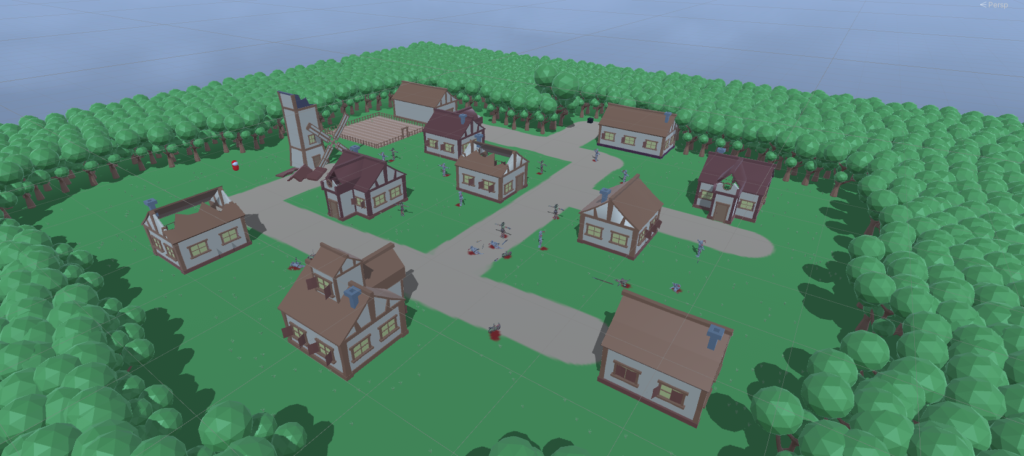
Now I can look at the “Where?” question. As the story flow describes, the first phase will take place on an abandoned battlefield in a village. Taking this in combination with the theme and style, I can start looking for assets and bring them into the scene. This is the result:

I had to modify some assets myself to suit my needs, such as making the buildings appear broken. However, this still doesn’t make it look like an abandoned battlefield yet. This will be discussed and created in the Environmental storytelling chapter.
Events and Obstacles
When thinking about how I would like to implement the events (set pieces) and obstacles within the game, I concluded it would be best to combine these two to be sure the obstacle would be combined with the narrative.
For the set piece I decided to go for something simple, that should amplify the feeling that the battle was recent. It also creates the obstacles, which the player needs to solve to continue. The result was a falling tree that looked like this:
To solve this obstacle, the player needs to look for a sword. When picked up, they can cut away the tree and continue towards the next part. This is how it will work:
After the tree fell, a sword will light up with the interaction particles.
After the player interacts with the sword, the tree will light up with interaction particles.
When the player interacts with the tree, it will disappear, and the player can continue.

Environmental storytelling
Static objects and Animations
To implement the static objects and animations, I need to think about why certain objects or animations are there (as discussed in the Storytelling Techniques chapter).
When looking at the mood board and thinking about the story, three things sprang to mind:
- Fire
- Dust
- Left weapons and bodies.
Below, each component will be discussed.
Fire animations
As explained in the story, the battle was very recent, and the village was abandoned. This caused that nobody had the possibility to try and save it and therefor, it seems to make sense to spread fire over the scene. This is how the scene changed after adding it:

Dust
Again, the battle was recent and caused a lot of damage. Particles just about to set after this massive battle, seem to make sense and therefore will be added as well. These particles aren’t objects or animations that can be pinpointed but they enhance the overall “effect” aspect of the “cause and effect” relationship.
This is how the scene looks like now:

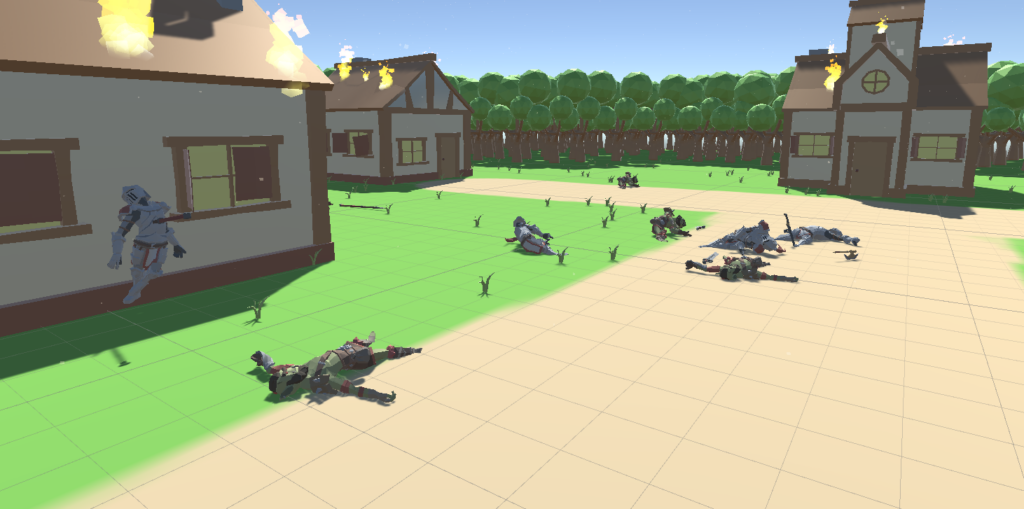
Weapons and bodies
When a battle just took place, other beings within the world, didn’t have the time yet to get rid of the remains of that battle. Just like the fire, it seems to make sense to add these to level and even make small vignettes to tell how some battles may have played out.
The following models are used for the knights:

And these models are used for the rebellion:
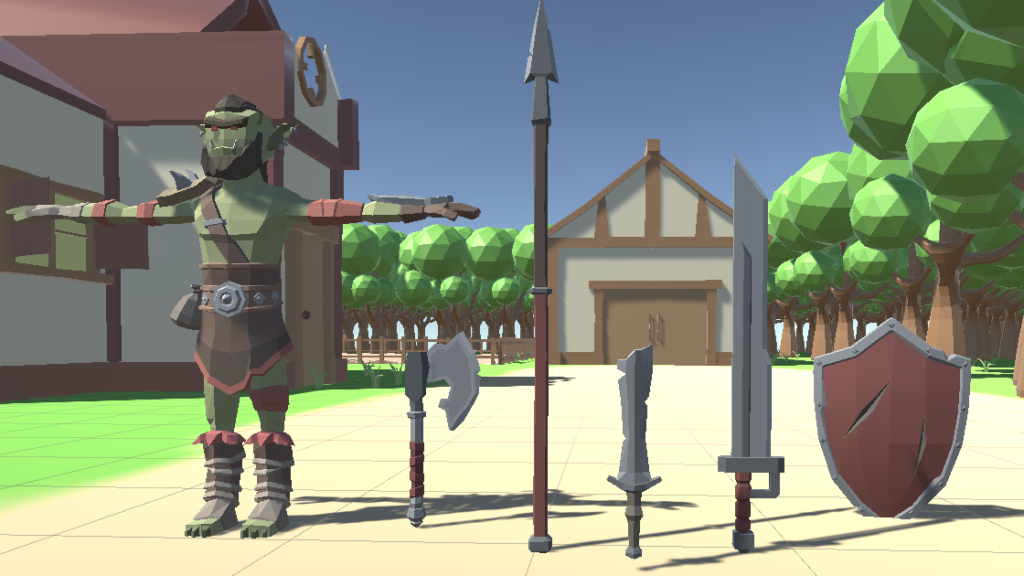
I couldn’t find anything like what I would like, so orcs would have to make do for now. This does mean I would have to take this in mind with the test later on since it won’t be knights against the rebels anymore, but knights against the orcs.
This is the result:


Color and Lighting
As discussed in the Storytelling Techniques chapter, color is often added in combination with lighting. This also counts for the other way around therefore I decided to add the two of them at the same time.
I had to decide on an overall color theme for the game. When looking at the mood board and the story, I found that the mood I wanted to create are mainly loneliness and emptiness. Based on an article of Navigator (2018), this would mean I would have to use the color grey. This color fit’s the emotion the best and feels the same for people located in Northen America and Europe.
Before starting with the lighting, I deleted the directional lighting since it doesn’t fit the mood at all. This is how the scene looked like before I added anything:
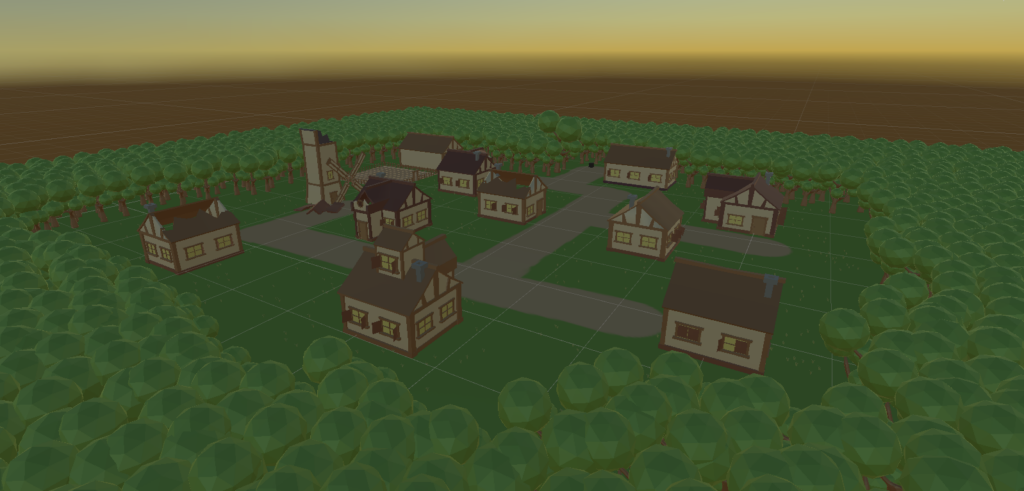
Now I can start looking at what kind of lighting I can use. When thinking about what kind of lighting I would like, I figured that ambient lighting would be the best place to start. For the ambient lighting, I found that a skybox would be the best option (2022).. After implementing it, the scene now looks like this:

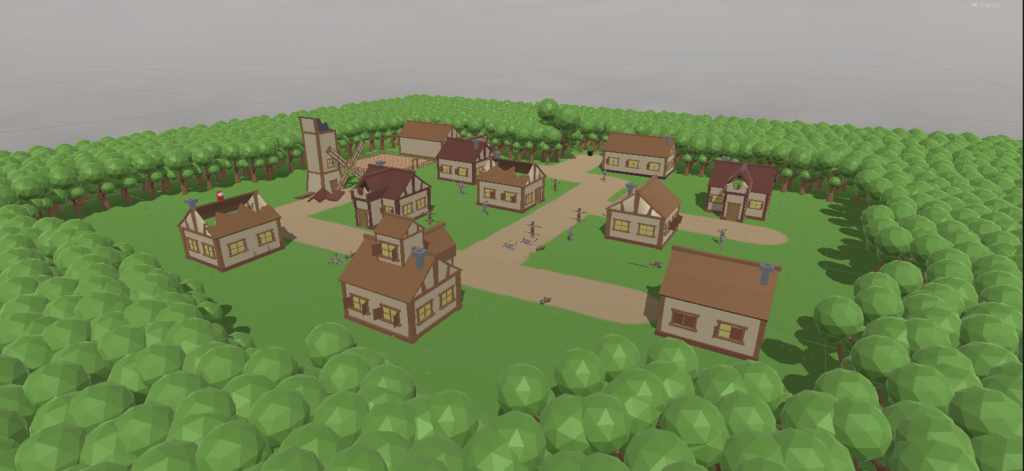
The scene is dark since there is no directional light anymore. Therefore, this would be the next lighting that needs to be added. After looking around, I found a package that had a directional light which would with the scene:
Furthermore, I would like to experiment with the spotlight or point light since I would like for the player to first go down the part. In the end, I decided to go with a point light since it would look the most natural. To do this, I made the following light:
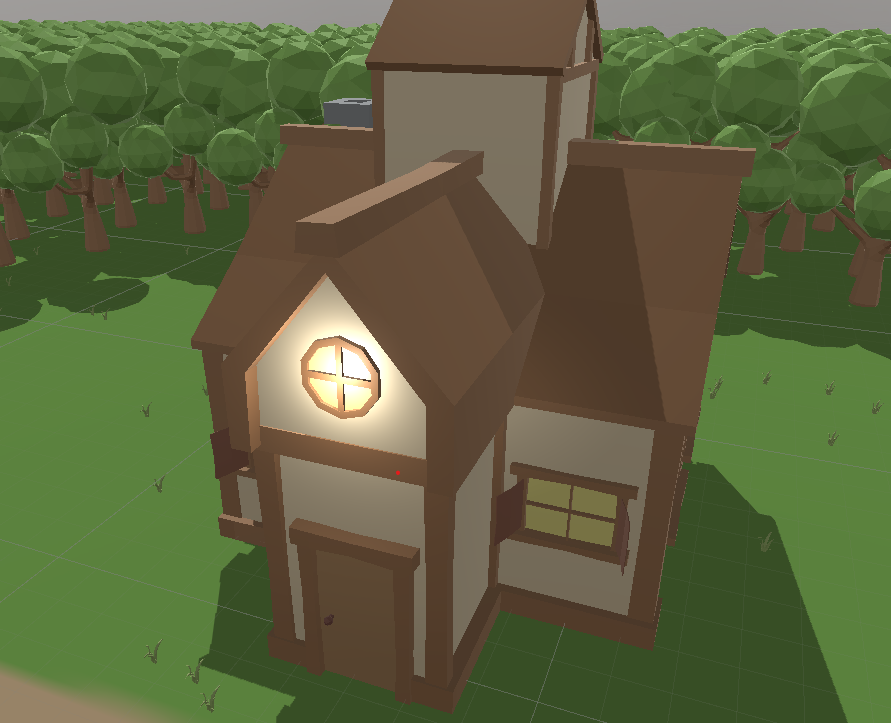
Doing this in combination with changing the start position of the player It should guide the player down the path. I also added point light to the sword, to grab the attention of the player when they need to look for it:

After doing all of this, I realized that the ground is too clean. So, I added some color to add the effect of blood:
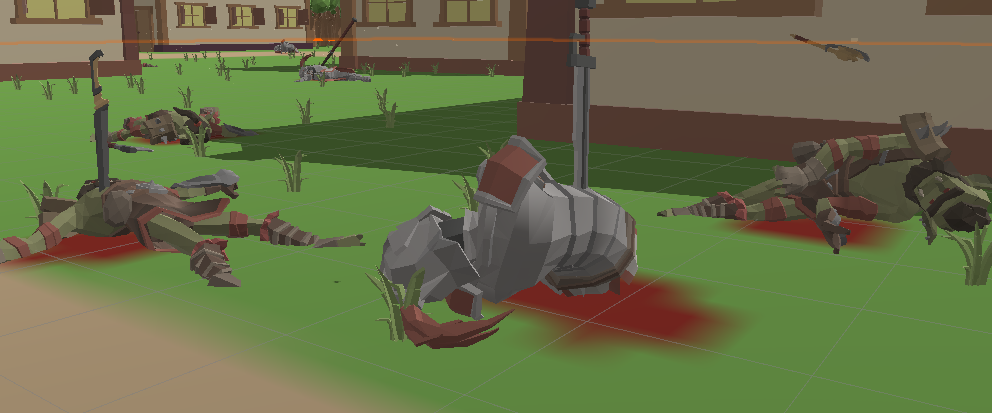
This is how it looks like now in game:
Post Processing
Just like everything else, it’s again important to see what kind of mood I would like to create to see which kind of Post Processing effects I can use. Based form the video from Brackeys (2020b) I figured that the following effects would great for my user’s case:
Color Correction:
Tone Mapper
Whit this effect, the scene will look a lot sharper and therefor be more immersive:

(Without this effect, the scene looks like it has something blurry on the lens.)
This must be done in combination with Post-Exposure, or the scene will be too dark.
White Balance
Whit this effect, I’m able to make the overall colors seem colder. This helps with emphasizing the grey color scheme I wanted to use:
Lens effects:
Depth of field
This effect, like the name says, creates depth within the scene. It’s subtle, so here is a before and after:
Before:

After:

General effects:
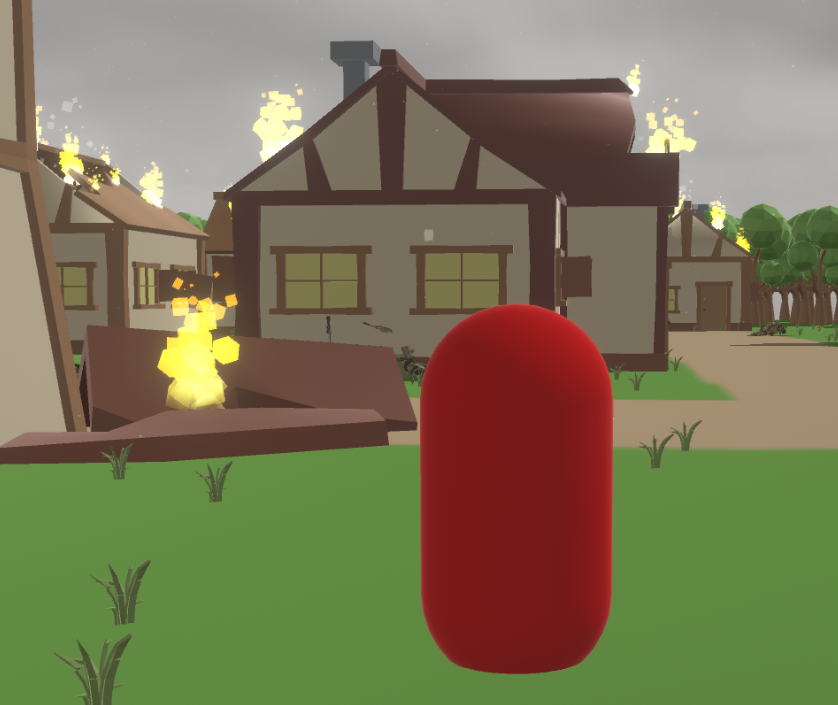
Bloom
This effect, will make bright area’s glow. Like the fire that’s in the scene:
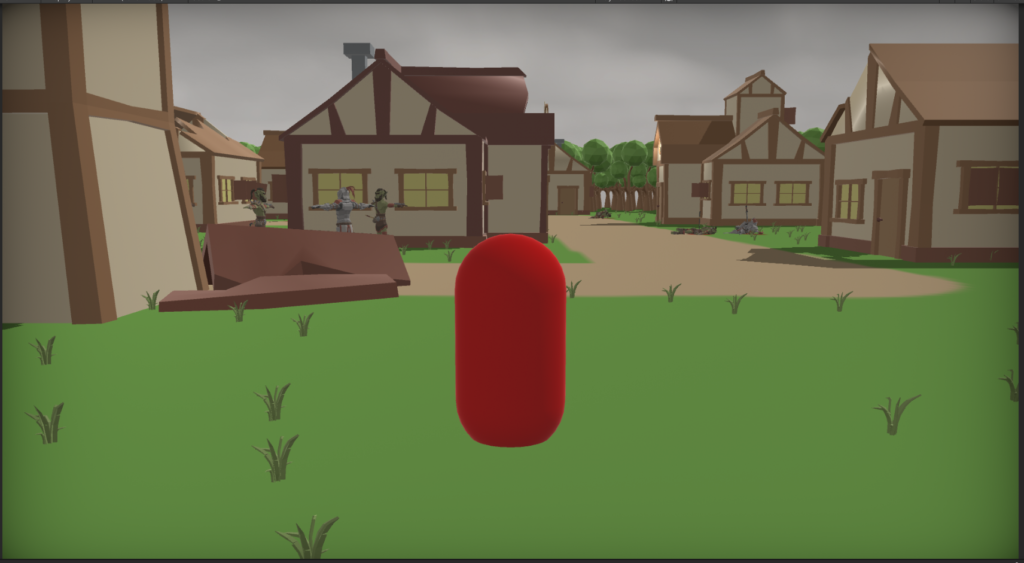
Vignette
This effect adds a dark border to the edges of the screen.
Result
All these effects combined, creates this:
Before:
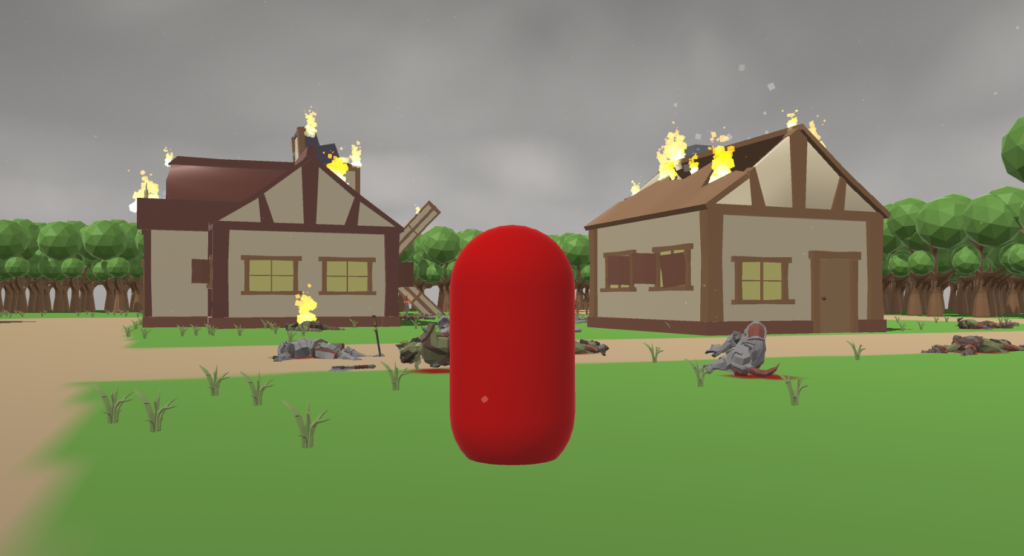
After:

5. Testing the scene
Information to gather.
Now it’s finally time to start testing. This part is important to see if the techniques I used worked and if I’m missing something. Out of the tests I would like to know the following:
- What did the player feel when playing?
- What does the player think happened/is going on story wise?
- How long did the player take to find the black cube int the end?
- Does the player understand what they need to do?
- Would the player like to continue with the game if there would be more?
Preparations.
To find these results, I will be using Blind Playtesting. This way of testing doesn’t give the player any instructions about how the game should be played and therefore the player needs to figure it out on their own (Moropo, 2023).
To collect the data, I will be watching players play the game and ask them to think out loud while I’m recording the gameplay. This way I’m able to see their reactions and look back at the feedback whenever I would need to. This way of collecting data is an excellent way to see where the game can be improved (Moropo, 2023). Out of the gameplay I should find the following data:
- How long did the player take to find the cube?
- Did the player say it was stuck? When and why?
- How long did the player spent in the level?
This means the total time spent in the level. This timer only stops when the player doesn’t want to walk around through the level anymore.
Furthermore, the player will be asked a few questions in the end to collect the player feedback (Moropo, 2023).
- What did you feel when playing the scene?
- What do you think the overall mood is of the scene?
- Do you have any idea what is going on in the scene story wise?
- Would you have liked to have experience more?
- Any feedback or tips you would like to give me?
At the end, after I’ve done multiple tests, I look if I can find any patters by analyzing the found data. I will also compare the results with the expect results. Analyzing the data like this, can lead to decisions that can help improve the player experience (Moropo, 2023).
Expectations
These are the expected results:
While playing:
- How long did the player take to find the cube?
3 minutes. - Did the player say it was stuck? When and why?
No. - How long did the player spent in the level?
5 minutes.
After playing:
- What did you feel when playing the scene?
Curious and sad. - What do you think the overall mood is of the scene?
Empty, sad, mysterious. - Do you have any idea what is going on in the scene story wise?
Fits the description inside of the script and story flow. - Would you have liked to have experience more?
Yes. - Any feedback or tips you would like to give me?
No.
Tests
Below, each individual test is described:
Player 1:
Played on Mouse and Keyboard.
While playing:
- How long did the player take to find the cube?
02:10 minutes. - Did the player say it was stuck? When and why?
No - How long did the player spent in the level?
03:38 minutes.
After playing:
- What did you feel when playing the scene?
Curious : What happened here?
Confusion: Sword takes tree down? Axed seems more plausible.
Amazement: Scene looks amazing.
Unfortunate: The end wasn’t very nice. - What do you think the overall mood is of the scene?
Mystery, tragedy, sadness. - Do you have any idea what is going on in the scene story wise?
A city is raided by orcs and the knight wanted to defend this. This didn’t work and everyone died. The reason as to why, is still unknown. The house that stands alone with the light, seem to have to do something with it? - Would you have liked to have experience more?
Yes, I would to be able to do more inside of the level to have a longer gameplay experience. This could be done with more puzzle elements! - Any feedback or tips you would like to give me?
The trees all look the same, the rest looks amazing. The controls are a bit janky. I would like to explore the city more and figure out why this all happened. It’s also very quiet… I would love to have some sound!
Player 2:
Played on controller
While playing:
- How long did the player take to find the cube?
03:12 minutes. - Did the player say it was stuck? When and why?
No - How long did the player spent in the level?
10:05 minutes.
After playing:
- What did you feel when playing the scene?
Curious: What is happening here?
Sad: It looks very sad.
Emptiness - What do you think the overall mood is of the scene?
Sad and loss. - Do you have any idea what is going on in the scene story wise?
There was a recent battle in a place where people lived. None of the parties won anything out of it and the city is now empty. Maybe it’s something that happened, something that will happen in the future or a dream? - Would you have liked to have experience more?
I didn’t get to hear anything, so I’m curious what is going on. I’m curious what the game tries to tell me. If the weird things in the game are gone, then yes, I would like to experience more.
What do you mean with weird things?
The player character doesn’t fit the scene, the buildings looked fine besides the fires, the grass looks like nothing happened with it and the fires doesn’t seem to emit light. - Any feedback or tips you would like to give me?
Maybe more rubble would be a good idea to make the grass less clean? Like footsteps, rocks, and other things.
Player 3:
Played on controller.
While playing:
- How long did the player take to find the cube?
02:54 minutes. - Did the player say it was stuck? When and why?
No - How long did the player spent in the level?
03:37 minutes.
After playing:
- What did you feel when playing the scene?
Curious: What happened here? Who am I? Where am I? - What do you think the overall mood is of the scene?
Mystery and sad. - Do you have any idea what is going on in the scene story wise?
It’s knights against the orcs. I don’t know if the knights won, everyone is dead, so I don’t think so. - Would you have liked to have experience more?
No, but I had a lot of questions, so I do want to know more. - Any feedback or tips you would like to give me?
Within the first minutes, I didn’t see the sword. It wasn’t clear that I could pick it up, until I tried some buttons. Maybe you could create a tutorial for the interact button? Also, the scene was a bit too dead for my taste. Could you maybe make it livelier? By the usage of animations or any other kind of movement?
Player 4:
Played on controller.
While playing:
- How long did the player take to find the cube?
01:38 minutes - Did the player say it was stuck? When and why?
No - How long did the player spent in the level?
02:00 minutes
After playing:
- What did you feel when playing the scene?
Happy, but then the scene get’s darker and darker. - What do you think the overall mood is of the scene?
The assets suggest a happy cartoony scene, but all the bodies and fire making it dark. - Do you have any idea what is going on in the scene story wise?
The village is attacked and is set on fire. Humans were attacked. - Would you have liked to have experience more?
Yes, the gameplay was way too short. - Any feedback or tips you would like to give me?
I would have liked a tutorial.
The controls were a bit weird. The character didn’t move in the direction of the camera, which I expected.
When walking over a body, I got launched. This doesn’t make sense.
Gameplay is too short.
Player 5:
Played on controller.
While playing:
- How long did the player take to find the cube?
04:15 - Did the player say it was stuck? When and why?
No - How long did the player spent in the level?
04:30
After playing:
- What did you feel when playing the scene?
Curious: What happened here? - What do you think the overall mood is of the scene?
It’s a dangerous world, dark and realistic. But once I saw the orcs, I also thought more about a fantasy setting. - Do you have any idea what is going on in the scene story wise?
Orcs attacked the village, knights tried to defend. I think the villagers ran away, since there is no audio to confirm that they still are.
What is the black box???
Village look really empty and I think the village wasn’t doing very well. - Would you have liked to have experience more?
I would have like some villagers I could approach and ask some questions. - Any feedback or tips you would like to give me?
The jump mechanic didn’t seem to have a goal, so why is it in the game?
At one moment I got really slow and I don’t know why.
Overall results
Based on the tests, there are results that match the expectations, results that don’t match the expectations and there is a lot of feedback given. Below, the different results will be discussed.
Expected Results:
- The average time that a player took to reach the cub, matches the expected time.
- None of the players got stuck.
- Most of the players (4 of the 5) matched the expected feelings and mood of the scene.
- The story is clear for the players.
- Players wanted to experience more. They all had questions about the story and would like to know more.
Unexpected Results:
- As soon as the players found the cube, most of them where done. This meant that most of the players didn’t reach the expected time a player would spend in the level.
- A single player found the scene to be happy. They said this was because of the cartoony art style that is used (low poly is seen by them as cartoony).
- 2 out of the 5 players wanted more gameplay. The found the level too short.
Overall feedback:
- The scene is quiet. With some sound, it would make the scene a lot more interesting.
- It wasn’t clear what button did what, till the player just tried some buttons. A tutorial for the movement and interaction would be great.
- A player asked as to why there is a jump mechanic when it isn’t used.
- They way the character moved, wasn’t satisfactory. It didn’t seem to move the way the player would have like to.
- The end was not exciting at all, meaning it wasn’t satisfactory.
- The scene seems to be a bit too dead for a player. Meaning, they would like some animations or something like this, to make the scene livelier.
- Grass is too clean for a recent battle.
- Trees look the same, creating a very dull looking background.
- There are two different bugs within the game. One being that the player can launch himself when walking over a sword like object. The other is that the player can suddenly walk slow, almost like its speed is halved.
6. Second iteration
Preparations
For this iteration, I will be looking at the test results and see what a good idea would be to research and implement into the scene. These are the points I decided to research further:
- The player character. Based on the test I did; the player character doesn’t fit the scene and therefor breaks the experience. I know that a model and animations will help this, but I don’t know what I need to keep in mind when deciding on these. This is why would like to research his.
- Audio. Players found the scene too quiet. This is why I would like to research what kinds of audio I can implement within the scene and what the overall goal should be when using this.
And these are the points I can implement or take a better look at based on previous research:
- The trees consider repetitive, and the grass and path are too “clean”. This is just changing or adding models and colors. It won’t require any further research since all the theory has already been discussed.
- Animations within the scene. This was discussed in the environmental storytelling subchapter. The set pieces that I added where appreciated, they just wanted more. It’s important to look at how I could do this and where I should do it and why.
- The mechanic. This was discussed in the level design subchapter. It’s important to look back, why I decided to put certain mechanics in the game and if I should leave them in.
Lastly I would like to do some bug fixing and other small changes. These small changes are either requested by the players (as seen in the results of the tests) or are found by me.
New Research
The player character
In order to create a main character that fits the game, it’s important to know what kind of genre the gameplay is tied to, what kind of character the main character is and how the player can feel unified with the main character. (Elomaa, 2021). When these things are decided, they can be used for game design choices. In combination with the script, it can also help with deciding on things like what the character is are wearing, how they move around, and what their voice would be like.
Types of main characters
The type of main character, affect the narrative possibilities of the game. There a several types of main characters. These are the following:
- Silent character: Used to allow the player imagination to fill in the dialogue. In some cases, it’s used to make the player feel like they are the characters.
- Cinematic character: Characters with their own personality, traits and wants. For this kind of characters, it’s important to look at what’s believable for the player.
- Open character: Player defined characters. Options let the player be their characters. They require more work than the other options.
(Elomaa, 2021)
Types of unity
When we talk about Unity, we mean how the player and the main character can relate to one another. These are the different types of unity that can be used within games and most of the times, they are combined:
- Unity of Purpose. Wanting the same thing as the main character. This can be done by sharing feelings, thoughts, secrets, choices, etc. It only works when the player feels empathy towards the main character.
- Unity of Action. The character does, what the player wants. This means that the action the player needs to perform must feel right and be believable.
- Unity of Trait. Also known as characterization consists of what the character seems to be. Things like height and weight. This is applicable when open characters are used.
(Elomaa, 2021)
Example
Let’s look at the Last of Us and see if we can find the theory within this game.
Joel is the main character.

Figure 14, The Last of Us (2023)
Joel has his own goals and personality which are defined within the script. These traits are reflected on his face, posture, voice, and clothing which also align with the genre (modern-day survival). Joel isn’t defined by the player, which makes him a cinematic character.
The Last of Us uses Unity of Purpose as well as Unity of Action. Unity of Purpose is already established at the very beginning of the game where an event created a huge impact on the main character. By doing this with the player, it creates a share of feelings. Unity of Action is done throughout the game, by matching the actions of Joel by what the player finds believable. A perfect example would be the moment when Ellie suddenly went missing. The player feels like Joel would want to find her as soon as possible and thus Joels dialogue and actions are created towards that.
Audio
Types of audios
There are different types of audios used within games. These are the ones I found based on a video of the GDC (2023):
- Dialogue: The things that people are saying.
- SFX or sound effects. The sound that you hear from running water or wind going through the leaves.
- Foley. Contact sounds that the character makes with the environment. So, this is the sound used for things like footsteps.
- Overall, Music and Sound design. Sound that is heard throughout a piece of gameplay.
These all combined should create the atmosphere (or mood) of the game and should reflect and drive the narrative.
Example
Let’s look at an example, to see what, where and when audio is used. The video below is the first 15 minutes of the Last of Us and so it will contain spoilers.
In this scene, all the audio types can be found.
Dialogue audio is used for the conversations between the characters.

Figure 15, The Last of Us (2023)
SFX is used for the explosion and the static of the TV

Figure 16, The Last of Us (2023)
Foley is used when the player walks around
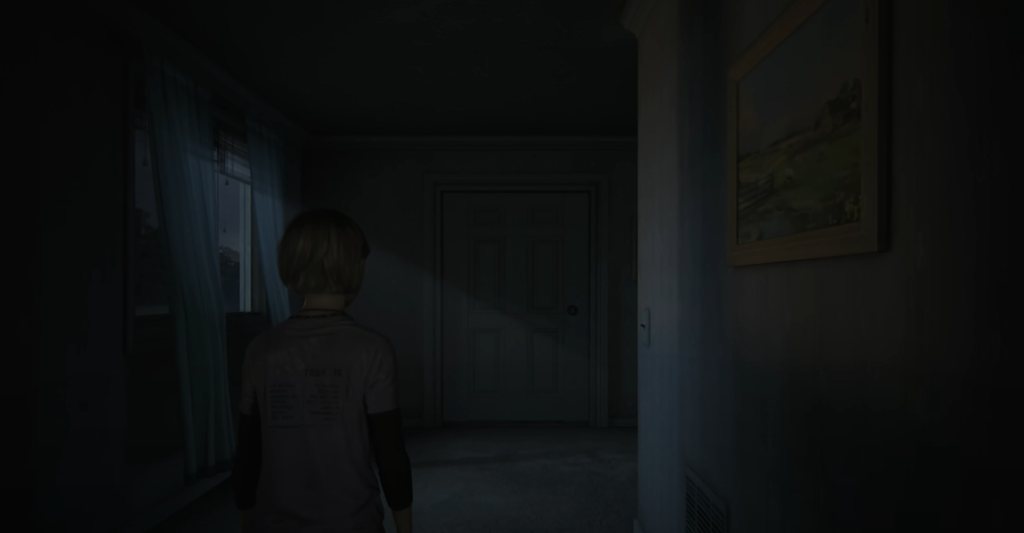
Figure 17, The Last of Us (2023)
Overall sound is used to accompany the feeling the scene should display.

Figure 18, The Last of Us (2023)
Barley any music is playing up until this scene. The music is very subtle, but it makes the scene more dramatic and therefore helps with telling the story.
Sequenced and Systematic audio.
Aside from the different types of audios within games, you also have a difference between how the audio can be used. There are two types of audio usage: Sequenced and Systematic.
Sequenced audio is a way of using the audio linearly. There is no adaptation of the sound, and the audio is used in more of a movie like style (GDC, 2023). It’s easier to implement than systematic audio.

Figure 19, GDC (2023)
Systematic audio, isn’t linear at al. It’s adaptable, creates a seamless gameplay experience and maintains the immersion for the player (GDC, 2023). To implement this, the sounds need to be able to react to situations, rather than just being told to play at an exact moment.

Figure 20, GDC (2023)
Implementation
The player character
Preparations
Within the story, the player character (aka the main character) has a set personality and goals. This is why I decided to go with a cinematic character. Furthermore, to create a Unity of Purpose I would like to use a much as facial expressions as I can to clarify that the character is curious and sad as well. To strengthen this Unity, it will be important for me to accomplish this in the last scene of this level where the feeling of hope should rise for as well the player as the main character (if there will be time to create this). The Unity of Action is already established, since the main character also wants to find out what happened and continue the road.
Model
Unfortunately, I have to same problem as before: I’m dependent on the assets that are given to me. Luckly, I found a model that seemed to fit Gerren’s (the main character) description well.

I had to make some changes to the face, to create a sad expression that fits his kind personality and the mood of the scene. These changes also give me the ability to animate the face later.

Animations
The feeling of Unity between the main character and the player, will break when the character doesn’t move in a believable way. This is why I decided to add some basic animations to the character, keeping the genre and the characters personality in mind. I tried to go for animations that would display his distress and that he was a participator in the war. I also had to animate the face, so he would blink one in a while. This will help with the believability of the character movement:
Audio
Preparations
Based on the research I decided to go with the Sequenced way of using audio. I won’t need highly adaptive sound, and this is easier to implement that Systematic audio. Furthermore, I decided to add these types of audios to the following situations:
- SFX
- Subtle crackling of the fire. This will help with the creation of the atmosphere.
- The tree that falls. This will help focus the players attentions on this obstacle, guiding them towards the path they should follow.
- The sword that is picked up. Since there is no animation to show that the player picked the sword up, a sound should help clarify this action instead.
- The tree that is cut into two. Again, there is no animation for this, so a sound should clarify the action.
- Foley
- Player footsteps. This will help with the creation of the atmosphere and the believability the player is interacting with the world.
- Overall music and sound design
- Very subtle fantasy music, which should amplify how sad and dangerous this situation is and was.
Chosen sounds.
These are the sounds I chose:
SFX
Fire:
Tree that falls:
Sword pickup:
Tree cut in two:
Foley
Footsteps:
Overall, Music
Result
And this is the result of the audio within the scene:
The Trees, Grass and Path
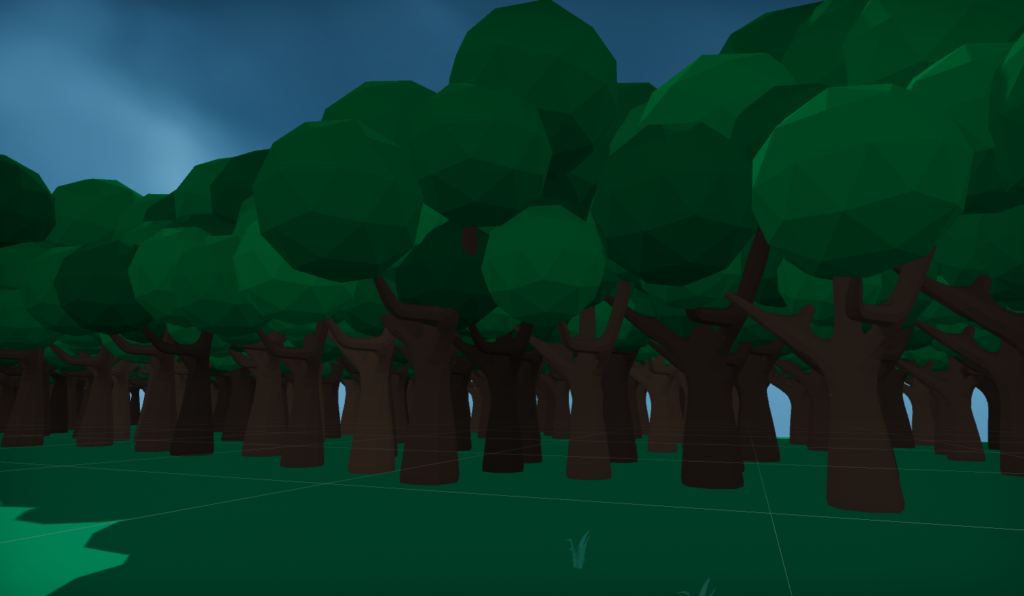
Trees
In order make the trees fit the scene more, I decided to change the green color of some of the trees to either being a darker green or a lighter green. I also increased the height and lowered the saturation of the overall colors. By lowering the saturation, the feeling of unease and insecurity will increase (Pérez Andreu, 2019).
Grass
For the grass I wanted to make the ground surface overall rougher, to get rid of that smoot/shiny look it has. I did this by using a different texture and by adding dirt. I also wanted to, like the trees, lower the color saturation.

The blood now also draws the attention of the player more, because of the high contrast it has with the dark green (Pérez Andreu, 2019).
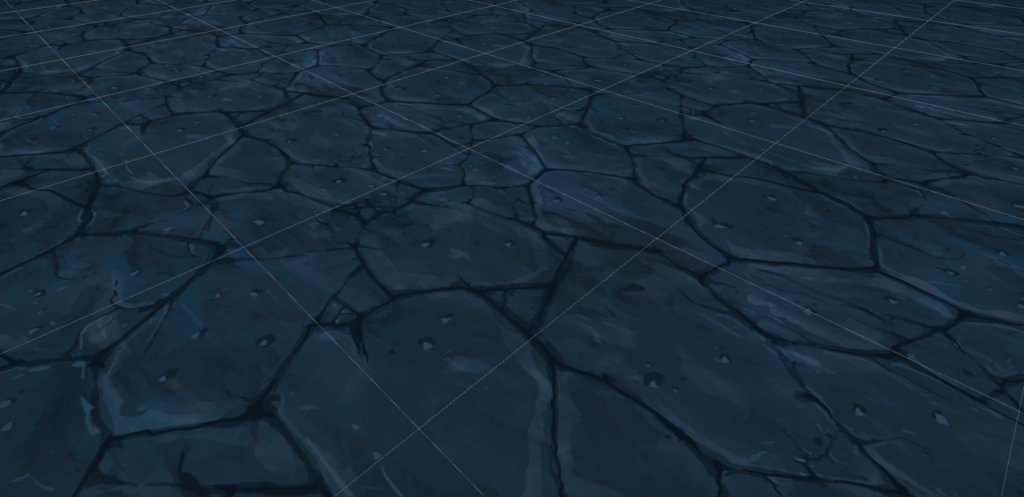
Path
I also decided to give the path a different look to fit the scene mor and to get rid of the “clean” feeling players had.
Set piece
A player stated that they would like some more things happening within the scene. To crate this and to emphasize that the battle was recent, I decided to add a set piece that shows the roof of a house collapsing. I also added a sound to clarify what’s happening
Sound used
Effect
The mechanics
When looking back at the research I did about the mechanics, I found something odd about my own conclusion. It doesn’t add up as to why the player would need a jump and sprint mechanic. Story wise, the main character, is a survivor of a war. He is wounded and is experiencing loss. It wouldn’t make sense, that a character who is feeling this way can run and jump around. Furthermore, the mechanics aren’t needed at all for the game.
This is why I decided to leave them out of the final product.
Other small changes
Button tutorial
I created a small tutorial for the players. I didn’t do any research for it since it is completely game design oriented.
This is how it turned out:

It appears when the player gets close to the sword and the UI changes to the controller scheme when a controller is connected.
Adding a light to the fires.
The fire wasn’t believable enough for players, since the fires didn’t emit any light. So, I added some lights to the particles:
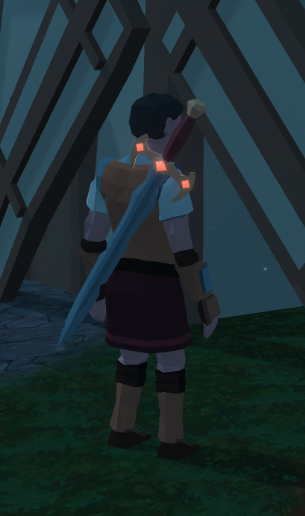
Sword appears on the back of the player
To make the action of picking the sword up even clearer and believable, I added it, so the sword appears on the players back when they pick it up:
Point Light House
Players thought that the point light within the house had something to do with the story. So, to prevent this I removed it.

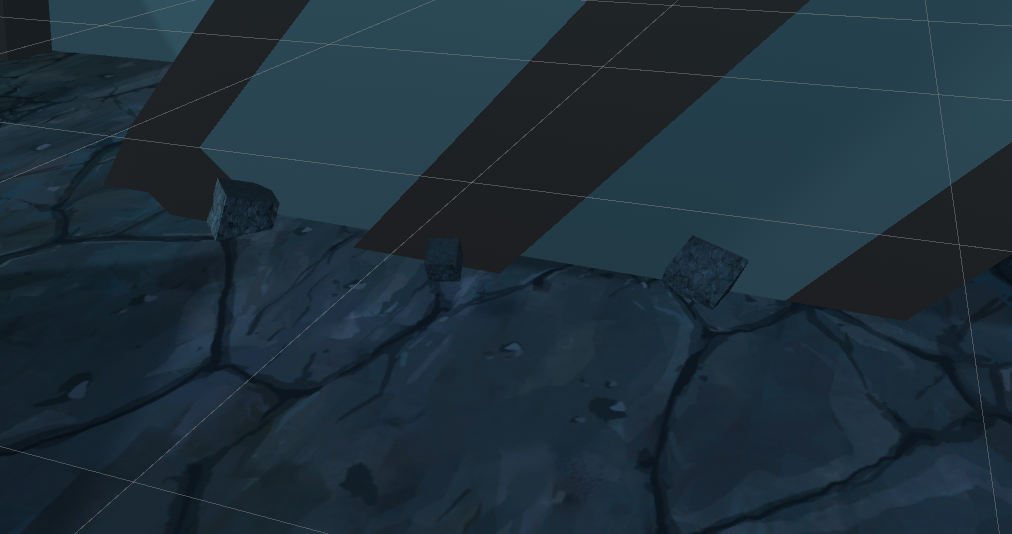
Rubble
The last thing I did was adding some rubble on the places of impact of the wicks and some weapons.
Fadeout
When the player reaches the end, there is a fadeout effect to clarify the ending of the scene. I did it to make the ending more satisfying for the player.
Result
7. Second Test
To see if any of the changes effected the player experience, I did a second test round, The test will be executed the same as the previous test and has the same expectations. The only difference is that question “How long did the player spent in the level?” is now irrelevant (the game ends after the player finds the cube) and the players that evaluate it.
Tests:
Player 6:
Played on keyboard.
While playing:
- How long did the player take to find the cube?
03:45 minutes - Did the player say it was stuck? When and why?
Yes, they didn’t see the that they could interact with the tree.
After playing:
- What did you feel when playing the scene?
Confused and Curious: What is going on?
Sad: The music and the bodies made it dark. - What do you think the overall mood is of the scene?
Tragedy and sad. - Do you have any idea what is going on in the scene story wise?
There was a recent battle. The knights didn’t win. The main character’s goal is to figure out what happened. You didn’t participate - Would you have liked to have experience more?
Yes, it’s a beautiful game. Manly because I had many questions. - Any feedback or tips you would like to give me?
No
Player 7:
Played on controller.
While playing:
- How long did the player take to find the cube?
05:05 minutes - Did the player say it was stuck? When and why?
No
After playing:
- What did you feel when playing the scene?
Sad: The music and bodies gave a dark atmosphere - What do you think the overall mood is of the scene?
Dark and sad - Do you have any idea what is going on in the scene story wise?
Village was raided by orcs. There was no winner. - Would you have liked to have experience more?
Yes - Any feedback or tips you would like to give me?
Maybe some more animations? So, I can see the tree being cut and such.
Player 8:
Played on Keyboard.
While playing:
- How long did the player take to find the cube?
02:59 minutes - Did the player say it was stuck? When and why?
No
After playing:
- What did you feel when playing the scene?
I focused on the testing of the scene, so I didn’t pay any attention on how I would feel. - What do you think the overall mood is of the scene?
Sad - Do you have any idea what is going on in the scene story wise?
A fight happened here. The main character is wounded and the only survivor. - Would you have liked to have experience more?
Yes. I have a lot of questions about the story. Who am I and what happened here? - Any feedback or tips you would like to give me?
I would like some more story.
Player 9:
Played on keyboard.
While playing:
- How long did the player take to find the cube?
03:15 - Did the player say it was stuck? When and why?
No
After playing:
- What did you feel when playing the scene?
It felt a bit sad. If this was either because I arrived to late to help them or because I was in the battle I didn’t know. - What do you think the overall mood is of the scene?
Melancholic. - Do you have any idea what is going on in the scene story wise?
There has been a battle. I have some kind of role within it. - Would you have liked to have experience more?
Yes, I wanted to know what happened here. - Any feedback or tips you would like to give me?
The camera felt like it was trying to center himself continuously. This didn’t felt very nice.
Overall results
Below the overall test results will again be discussed:
Expected Results:
- None of the players got stuck.
- The players experience of what the mood should be, match the expectations.
- The story is clear for players. Some even found that the player character is in fact wounded.
- Players wanted to know more about the story.
Unexpected Results:
- The average time a player spend within the level is higher than expected (the expected time was the same as in the previous test: 03:00 minutes).
Overall feedback:
- A player would like some more player animations to match the action with visual feedback.
- A player would like to experience more of the story.
- A player had some problems with the movement of the camera.
Difference
There are some differences between the results of the tests from the first iteration and the second one. I have arranged them below, to create an better overview:
Subject | First test round (5 players) | Second test round (4 players) |
The average time spend | Around 03:00 | Around 03:30 |
Story experience | Knows only about the battle and there being no outcome. | Knows about the battle and the main character being either wounded or an observer. |
Feedback point amount | 9 | 3 |
These differences prove that the overall experience has been improved and that the story about the main character is better understood. So, the color, audio and changing the player character to fit the scene help with improving the storytelling of the narrative.
8. Conclusion:
This project taught me about the three levels of storytelling and what each level covers. I learned how to implement story trough mechanics, play space, theme, set pieces, and obstacles. I also learned that the implementation of the mood of a game can be done through Environmental Storytelling, which uses things like vignettes, color, lighting, and post-processing effects. Lastly I learned how important it is to evaluate the game with players. Players provide a different perspective on the game, bringing things to light you don’t think about initially.
The project was a wonderful experience and thought me a lot about storytelling. Even though I learned so much, I was only able to scratch the surface of Environmental Storytelling. Environental Storytelling also looks at materials, shapes, scales, etc. all things I was not able to research. This is why I would like to go even more in depth if I am to continue this research.
I would also like to expand the scene to the extend that a full level would be playable, instead of only a third. This could teach how I can ease a switch of emotions between scenes, since the last scene of the first level should display hope instead of despair.
Overall, I am happy with how the last itteration of the scene turned out. I was able to create the atmosphere that I wanted, and all the players said they wanted to experience more of the scenery and story. This gives me the confidence that with my new acquired knowledge I can tell a stories to players, even though I have Dyslexia.
9. Sources
- Adams, E. (2014). Fundamentals of Game Design (Third Edition). New Riders.
Source:
https://ptgmedia.pearsoncmg.com/images/9780321929679/samplepages/0321929675.pdf - Andersen, N. (2019, 28 Mei). Master Thesis Environmental Storytelling In Story worlds.
Source: https://projekter.aau.dk/projekter/files/306255849/Masters_Thesis_Environmental_Storytelling_In_Storyworlds.pdf - Brackeys. (2020, 24 May). THIRD PERSON MOVEMENT in unity. YouTube.
Source: https://www.youtube.com/watch?v=4HpC–2iowE - Brackeys. (2020b, Juli 5). EVERY image effect in unity explained – Post Processing v2 tutorial. YouTube.
Source: https://www.youtube.com/watch?v=9tjYz6Ab0oc - Brazie, A. (2023, 30 September). Video Game Mechanics: A Beginner’s guide (with examples). Game Design Skills.
Source: https://gamedesignskills.com/game-design/video-game-mechanics/#what-are-video-game-mechanics - Carson, D. (2000, 1 March). Environmental storytelling: creating immersive 3D worlds using lessons learned from the theme Park I . Game Developer.
Source: https://www.gamedeveloper.com/design/environmental-storytelling-creating-immersive-3d-worlds-using-lessons-learned-from-the-theme-park-industry - Chat GPT for advice when code wasn’t working correctly or to explain concepts so I could search on different terminology.
- Code Monkey. (2021, 5 August). How to use NEW Input System Package! (Unity Tutorial – keyboard, mouse, touch, Gamepad). YouTube.
Source: https://www.youtube.com/watch?v=Yjee_e4fICc - Collins, P. (2023, 2 February). Game level design: how to do it and with what tools | Starloop Studios. Starloop Studios.
Source: https://starloopstudios.com/game-level-design-how-to-do-it-and-with-what-tools/ - Devashree. (2023). What is game environment design and how to get started?
Source: https://www.devstree.com/what-is-game-environment-design-and-how-to-get-started/ - Elomaa, M. (2021). GUIDE TO CHARACTER WRITING IN VIDEO GAMES. Bachelor’s thesis Degree program in Game Design.
Source: https://www.theseus.fi/bitstream/handle/10024/747903/mikko_elomaa.pdf?sequence=2 - Galuzin, A. (2016, 21 November). How to Plan Level Designs and Game Environments in 11 Steps. World of Level Design.
Source: https://www.worldofleveldesign.com/categories/level_design_tutorials/how-to-plan-level-designs-game-environments-workflow.php - Game Maker’s Toolkit. (2020, 11 March). How level design can tell a story. YouTube.
Source: https://www.youtube.com/watch?v=RwlnCn2EB9o - GDC. (2017, 6 June). Level Design Workshop: A Narrative Approach to Level Design. YouTube.
Source: https://www.youtube.com/watch?v=FhKjv7CPUqw - GDC. (2023, 7 Augustus). “Dark Pictures: Season 1”: 4 games in 4 years: Audio systems for narrative horror. YouTube.
Source: https://www.youtube.com/watch?v=hr-D-wtK0Ew - Hogwarts Legacy. (2023, 10 February).
Source: https://store.steampowered.com/app/990080/Hogwarts_Legacy/ - Hollow Knight. (2017, 24 February).
Source: https://store.steampowered.com/app/367520/Hollow_Knight/ - Journey. (2020, 11 June).
Source: https://store.steampowered.com/app/638230/Journey/ - Kauranen, A. (2023). How colours guide the player in video games. Theseus.
Source: https://www.theseus.fi/handle/10024/796721 - Kelly, T. (z.d.). Set Piece. What games are.
Source: https://www.whatgamesare.com/set-piece.html#:~:text=Some%20games%20guide%20or%20push,around%20delivering%20one%20after%20another - Limbo. (2011, 2 August).
Source: https://store.steampowered.com/app/48000/LIMBO/ - LMHPOLY (2020, November 11). Unity 2020 Tutorial – Lighting and Post-Processing Low Poly Scene.
Source: https://www.lmhpoly.com/tutorials/unity-2020-tutorial-lighting-and-post-processing-low-poly-scene - Moropo (2023, July 7) What is playtesting?
Source: https://www.moropo.com/post/playtesting - Murisier, L. (2022, 29 November). How to write a video game script.
Source: https://freshmenscreenplay.com/how-to-write-a-video-game-script/ - Navigator, C. (2018, 5 December). Color psychology.
Source: https://blog.colornavigator.net/color-psychology#:~:text=In%20Europe%20and%20America%2C%20grey,with%20rainy%20days%20and%20winter. - Pérez Andreu, S. (2019, 1 October). Level design: resources and techniques to guide the player.
Source: https://upcommons.upc.edu/handle/2117/173957 - Rouse, R. (2010) “Environmental Narrative: Your World is Your Story.” Game Developers Conference, San Francisco CA.
Source: http://www.paranoidproductions.com/miscwritings/EnvironmentalNarrative.ppt - SpaceDraft. (2022, 14 September). Video game script writing – How it’s done | SpaceDraft.
Source: https://www.spacedraft.com/knowledge-base/video-game-script-writing-html/#1 - Storyteller. (2023, 23 March)
Source: https://store.steampowered.com/app/1624540/Storyteller/ - Technologies, U. (2022). Unity – Manual: using skyboxes.
Source: https://docs.unity3d.com/Manual/skyboxes-using.html#:~:text=After%20you%20create%20a%20skybox%20Material%2C%20Unity%20can%20use%20it,to%20the%20Skybox%20Material%20property. - TED-Ed. (2020, 25 June). First person vs. second person vs. third person – Rebekah Bergman [Video]. YouTube.
Source: https://www.youtube.com/watch?v=B5vEfuLS2Qc - The Last of Us (2023, 28 March). Steam.
Source: https://store.steampowered.com/app/1888930/The_Last_of_Us_Part_I/ - Tomb Raider (2013, 5 March).
Source: https://store.steampowered.com/app/203160/Tomb_Raider/ - Vredenberg, B. (2017). Signposting, Mise-en-Scene, and Environmental Storytelling. Utrecht University.
Source: https://studenttheses.uu.nl/bitstream/handle/20.500.12932/26654/Master_Thesis_Bjorn_Vredenberg_3477096_v2_2.pdf?sequence=2&isAllowed=y - Wei, H., & Durango, B. (2019). Exploring the Role of Narrative Puzzles in Game Storytelling. School of Design, The Hong Kong Polytechnic University.
Source: http://www.digra.org/wp-content/uploads/digital-library/DiGRA_2019_paper_410.pdf - Wilson, S. (2022, 1 May). Writing Screenplays Without dialogue \ Raindance Film School London. Raindance.
Source: https://raindance.org/writing-screenplays-without-dialogue/ - Zakowski, S. (2016). Environmental storytelling, ideologies, and quantum physics: Narrative space and the BioShock Games.
Source: https://biblio.ugent.be/publication/8066134
