

When considering learning through games, there are usually two types of games. Either the game is an educational game, where the focus is on learning, or the game is an entertainment game, and there is no focus on learning at all. I believe though, that the entertainment game still teaches players a lot, but on a more subconscious level.
So, my hypotheses is as follows: Players learn from playing games on a subconscious level.
Think:
I started with researching some musical theory. I grabbed my old music study books out of the closet and started looking for some teachable aspects. Since I want to take a step away from the feel of educational games, I’ve been looking for concepts, more than theory. Teaching a scale is about repetition, memorizing and variation in repetition to fully save the information. But a concept, such as melodic contours, can be taught through game play (Blass & Tolnai, 2019).
- Interact with the cuboid to hear the melody the player needs to match.
- Interact with one of the 5 cubes to hear the note that cube represents.
- Interact with a second cube to get them to swap places.
- If the order of the cubes is the same as the melody the player solved the puzzle.
This can be modulated to puzzles as big as the designer wants, add cubes, make the array longer or shorter, it is all possible. I added some movement animations to make it appear smooth. Next will be turning the cubes into models, and make some more environment for immersion. Also I’ll need to check if the puzzles are:
- Fun
- Understandable
- Solvable
I researched didactic theory, on teaching new concepts. Repetition and variation on the teachable concept are very important. Also real-life context is very important. When contextualizing theory, the player can map the information onto their existing paradigms (Bevensee, 2012). I combined that with research about how a proper tutorial is made. Tutorials are designed to teach the player about in-game systems. That’s why I think I will model this project as if it was a tutorial for a larger game. It gives me a nice thematic mantel to keep everything under.
Make.
I chose a 3D environment, with a 3rd person view. I place the player in the bottom left corner, adhering to the rule of thirds (Soegaard, 2023), because I want the player to have full view of the game world, since they will be puzzling, the player’s character shouldn’t obstruct the view. I started with the unity 3rd person template, because I didn’t want to spend time on building a character controller. I tweaked it to my liking, removed the environment and started designing my own. I added a fermata symbol as a crosshair to keep it in the musical theme. Then I added a simple plane, and some interactable objects in the world. There is one big cuboid with 5 cubes next to it. Now it works as follows:
I will make a puzzle prototype, where the player needs to match melodies. The get to hear an example melody, and then they need to put musical flowers in the right order to match this melody. I want to next, think about stripping away information in later iterations of the puzzle, so that the player needs less and less information to be able to solve the puzzle. So puzzle one is a step by step explanation of the puzzle. I tell the player they need to make an ascending melody, accompanied by a symbol of an ascending line. Then later, after some steps, the player should need only the picture of an ascending line to understand that they need to make an ascending melody out of the flowers.
Check:
For the check I did two things this week. The first was going over my work with the guild. I showed them my ideas, and what I am trying to accomplish. Some important feedback I got was to keep an eye on scope, this project can easily grow out of proportion. Second was that I should do one puzzle variation good, before going on to the next. The third piece of feedback I got, was that I should still look at the way my puzzle works. People like autonomy and the illusion of freedom. For instance:
NPC: “Make an descending melody” (/) <- image of an ascending line. “Use these flowers to do so”.
So not, match the melody, but, create this melody. This gives them more space for experimentation, to play around, and learn through that. I can then still strip away information given to the player all the way to the point where players are making ascending melodies simply because they saw an ascending line.
This week I will focus on:
- Iteration on the puzzle.
- Importing an asset pack with some environmental models.
- Design an environment where the puzzle can be found.
- Think about steps in the puzzle, where the puzzle can get more and more complicated, and the instructions get less and less obvious.
- Get started with some music.
- If the iteration on the puzzle feels nice, I won’t need complete melodies. I will need notes for the individual flowers. These flowers’ notes should be playable as a melody. That will take some research.
Week 2.
Quick make. Before testing the prototype I found a free package asset with some simple nature elements, low poly. I turned the cubes into flowers in a pot and added some terrain and trees to liven up the scene. I got some piano notes for the web and assigned them to the flowers. I made a solution based on the height of the notes, and if the order of the flowers is the same as the solution, the puzzle is solved. Clicking on the sign starts a co-routine playing the notes in order. I don’t want the player to mess up the playing of the solution so I used a boolean flag to make sure the co-routine can’t start as long as it is still playing.


Check:
I had three people play-test my prototype. I focused on usability, game play and general things that catch my eye. For usability I focused mostly on how easy it feels for the players to play the puzzle. Not easy as in easy to solve, but easy as in easy to use. For game-play I looked at solvability. Can each player solve the puzzle without further instructions? I also kept an eye on user protection, can they mess up the state machine?
The player starts facing the puzzle. They see a sign with a symbol, 5 flowers in pots, and there are some trees behind it, blocking the frame. The first thing that I noticed is that none of the players looked away from the puzzle. They didn’t walk around, they didn’t look up, they were immediately focused on the puzzle. This is a good sign, it appears to be eye-catching and immersive enough at this point.
I noticed that the usability can be improved. Having the flowerpots play the note when they rise and lower is too much. It also takes two clicks, I think I need to rethink how I’m handling that. There should also be an option to play what the solution should be. The player can use that as reference point during puzzling. It’s like the box of the puzzle showing what the end-result should be. The solvability was good. 2 Adult testers solved the puzzle within minutes. 1 Did it within 20 seconds, the other under 2 minutes. One child tester took a bit longer, she had less experience with music in that sense, so it was a bit tough for her. But she did solve it, on her own. So with better UI and explanation this should be settled. No player managed to mess up the state machine, so for now I can accept that this works fine.
Make/Think:
With this new information in mind, I presented my guild with the state issue. Having to click twice to lower the pot is annoying if you just want to hear the note. One guild member suggested that I divide the flowers and the pot into two parts. Click the pot to raise it, getting ready to be swapped. Click the flower to hear the note. It completely solved my issue, so I took note of it and implemented it at a later time.

Next thing I wanted to add, for some visual feedback, is an aiming effect on the objects. I found this tutorial on Youtube, explaining how you can make separate layers holding different materials using a shader graph (Camp, 2021). Using some code I check to see if the player is aiming at an object on the ‘interactable’ layer. This way only objects holding the interactable layer will be able to switch layers. If so, the layer switches to ‘highlight’. I add some emission and set the alpha to 0.25 so that the original color is visible. A highlighted object looks like this:

I also added an optional tutorial canvas to the sign. I changed the symbol on the sign to a question mark for now, I want to iterate on that, making it something akin to a ‘melody puzzle’ symbol, leaving the option to create new puzzles in the same vein, but then for ‘rhythm’ and ‘harmony’. The next play-test, I will put a player in the game, without back-seat gaming. I have the tendency to explain ‘issues’ with my prototypes to the testers, to ensure that they are able to play. It skews results, because actual new players won’t have my voice to guide them. So this iteration I will truly step back and purely observe.

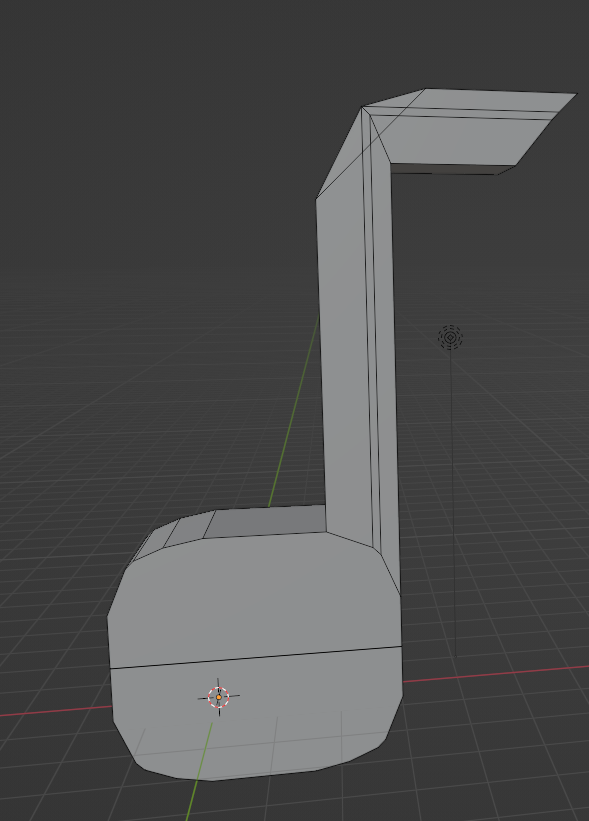
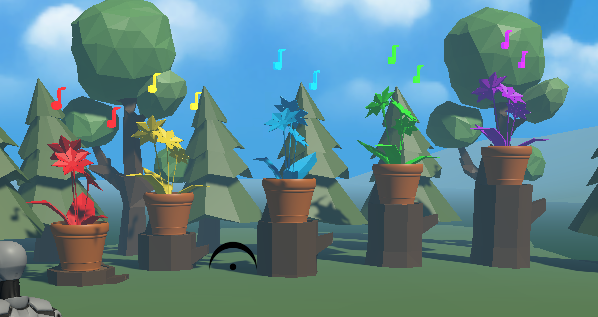
Lastly I added two elements. First i added some bobbing music notes surrounding the flowers, to ensure the player instantly sees it is a musical puzzle. I couldn’t find a proper free music note model online so I quickly made one in blender. It’s not the prettiest, but it suffices. Next I used some tree stumps from the simple nature pack to help support the idea of an ascending melody. Each flower pot is physically higher than the next, which I hope can help with learning the melody theory. The notes ascend both musically and physically. Some environmental storytelling to help the player understand the puzzle logic. (Bevensee, 2012)
Iteration:
Next week I’ll first be focusing on play-testing and checking in with the guild. I want to make sure that my choices have been sound and that they have the expected outcome/influence. Then I will be expanding the puzzle. I want to make at least three difficulties, adding flowers, and making descending and arching contours. The first puzzle is 5 notes, ascending. I think the next puzzle will be 6 notes, descending. And the third puzzle will be 7 notes and arching. One thing I think is that arching will be less difficult, because 7 notes in an arching melody can come down to 4 unique notes. C – D – E – F – E – D – C. I could go 7 unique notes as well: C – E – F – A – G – D – B. Something like that. That could be a fourth puzzle. But the important part is that the game-play stimulates saving the contour theory to memory. So I will need to start researching this part more thoroughly.
Week 3: Game feel
Think:
The guild meeting gave me some new insight in what my project needed. It was the first time I properly presented my work, so it was all new to their eyes, but the progress was well visible. After receiving their feedback I decided I wanted to work on three issues this week.
- Game feel
- Tutorial design
- Environment design
While the system worked, it didn’t feel fun to do. I took a good look at the system, it’s individual parts and interactions, and what I could strengthen. For some inspiration I took to Youtube, and with some additional video’s provided by my guild leader I found it. The video ‘Secrets of game feel and juice’ by Game Makers Toolkit (Brown, 2015), and ‘How to design with feedback and game feel in mind’ from Unity (Unity, 2019) helped me along greatly.
Make:
- Audio
First I wanted something of a score/soundtrack to strengthen the feeling of being in the world. I found some good free assets and implemented one. Since the puzzle is music based, I had to change the notes of the plants so that they wouldn’t sound dissonant when played. Future puzzles would have to be in the same key as well. I also changed the timing from playing the solution or the current melody, to fit the beats per minute of the soundtrack.
Next I looked for some SFX. I added a little magic sparkle to the lifting of the pots, to make that feel more magical. It’s not a magic game, and since the baton looks a bit like a wand, I will have to differentiate strongly so players will see the distinction. I also added a magical swoosh sound for when the pots are being swapped.
- Visual
The layer switch worked, but on the whole flower + pot game object. I wanted to separate those, to make sure the player could instantly understand there was a difference in what they interact with. I gave each object a separate collider, and then wrote a script that checks which the ray cast hits.



I wanted the plants to do something. I decided on having them rotate in place on their y-axis, a simple animation to make but it immediately livens the screen. Then when the player interacts with them, they quickly rotate to their starting position while they quickly grow a bit in scale and return to their normal size. Also two music notes appear and bob up and down while the note is playing. I handle this logic with the Unity Animator.
To strengthen the feel of picking up the pot I added a particle system that emits when the player interacts with the pot. They are a combination of the colors of the flower with the color of the flowerpot, to make each pot pick-up feel distinct. Ultimately I’m not super pumped about this yet, I will want to iterate on this later.

Lastly I looked at my current environment. There was no natural way to play the solution and the current melody, but a guild member came with the great idea to place some birds in the scene. I found a nice free bullfinch model, placed two on a branch in the scene and gave them distinct colors. I gave one a text-bubble to indicate that that represents the melody the player wants to change. Of course the birds are highlight able, so that the player knows they can interact with it.

I also changed the tutorial sign. I made it smaller, removed most of the information from the canvas and put it in a new place, out of the initial view of the player. It is just to the side. All it now says is: Sort the melody in the correct order. With an image of some stairs with an arrow to indicate the direction the melody should go in.


Finally I placed the birds on a big tree sump with some branches, high in the middle of the puzzle. To indicate their importance. I gave the solution bird some bobbing music notes to indicate it will sing when interacted with.

Check:
For an interesting check, I asked my mother to play. She is quite computer illiterate, so if she could understand what was going on on the screen, many others will as well. To get some proper insight, I told her only two things. First, WASD is for walking and the mouse is used for aiming. (This was completely new information for her). And second, when a game object lights up, you can click your left mouse button to interact with it. After that, I stepped back and let her figure it out. Initially, she walked right through the puzzle, giving her some panic, not knowing how to get back. So I restarted the scene, and called it a false start. The second time around she started to explore her options. She clicked on a pot, and again and saw it rise and lower. She then clicked on a flower and herd it play a note. She then clicked on the other flowers and her puzzle oriented mind started working. But she did not yet know she could swap pots. She looked around a bit, and saw the tutorial sign. She read the instruction and went back to the flowers. She then clicked on a pot again, and lowered it again. Then it clicked, she clicked on a pot, it raised, she first clicked on another flower, found it did nothing and then clicked on the pot and saw them swap. From there she started puzzling. She sorted the melody, however she didn’t see and process the image of the stairs, and she sorted it descending in stead of ascending. Funnily enough she never interacted with the birds.
Afterwards I asked her about a few things. First I asked her why she didn’t click on the birds. She wasn’t really sure. She saw them light up but the possibility of interaction didn’t cross her mind then. After that she found out she could swap the pots, and when she had a goal in mind, she didn’t care about the birds anymore. Second i asked her about why she sorted the melody descending. She said she didn’t see the image of the stairs, or at least she didn’t process it. This gave me valuable information.
Iteration:
The image of the stairs should be incorporated better and more visible. I will also iterate on the birds a bit. I’m thinking that the first bird won’t sing the current melody, it gives a lot away, then, when the player tries to interact with the bird and the melody is not yet correct, I can give the player direct feedback the melody isn’t there yet. Then, when the melody is correct, the bird will sing it, signalling it learned it. I will revisit the positioning of the birds as well. Their tree is too high and too in the middle.
I will iterate on the particle system of the pots as well. Maybe I should give it an animation, or a glow, or something along the likes. After that it is time to make more puzzles, and design the route the player will take, and how I can enforce the linearity. I will also do another play-test with the same players as the first play-test, to see how they experience the progress. I will also do research on the design of the puzzle and how I in the end will test if the players’ knowledge of musical theory has improved or not.
Week 4: Proving knowledge
Think:
First I defined my hypothesis. “A person can improve their musical knowledge by playing a musical puzzle game, without actively trying to do so”. To try and establish if a person has learned something, a proper methodology to find this out is Pre-Testing and Post-Testing (I-TECH, 2012). To prevent bias I will take some precautions. First I will not tell the testers what they are testing and why they’re filling out the questionnaires. They also won’t know the results of their tests until I’m done with processing the data. I will be doing a single-blind study (Clinical Research Glossary, 2021). For the test I will be using a multiple choice questionnaire with 100 questions divided over 5 subjects, Geography, History, Biology, Music, and Sport. https://theelearningcoach.com/elearning_design/rules-for-multiple-choice-questions/. Each question has 4 possible answers. The result will be a grade of 1-10 for each subject. This information will initially not be shared with the tester. With 20 questions for each subject, each question can garner 0.5 points. After the Pre-Test is done the tester will have a small report card.
Then the tester will play the game. The game will consist of 4 – 6 puzzles (depending on development time) with rising difficulty. After the tester has solved the 6 melody’s, they will take the test again. My hypothesis states that there should be an increase in the grades for music, while the other subjects remain consistent.
Make:
| Puzzle # | # of notes | # wrong notes | # of moves | Contour | Start order |
| 1 | 5 | 3 | 2 | Ascending | 12453 |
| 2 | 5 | 4 | 3 | Descending | 15423 |
| 3 | 6 | 4 | 3 | Arching | 134526 |
| 4 | 7 | 5 | 5 | Descending | 1567342 |
| 5 | 8 | 6 | 4 | Arching | 13248567 |
| 6 | 8 | 7 | 7 | Ascending | 24678315 |
This will be the order of the puzzles. I’ve designed this with a few things in mind.
- Up until the last puzzle, give the player a solid starting point. The first note is correct.
- Have each melodic contour appear twice.
- Increase the number of used notes, wrong notes, and moves to solve the puzzle in each iteration. Solving musical puzzles can be difficult for the less musically inclined ones, but if the increases are too small, I’m weary of making them bored.
- Have the final puzzle be a ‘test’ of sorts, no solid starting point, truly testing the limits of their new knowledge.
Questionnaire:
Since the testers will be Dutch, the questions will be in Dutch as well.
Pre-Test
| Tester | Geography | History | Biology | Sport | Music |
| #1 | |||||
| #2 | |||||
| #3 | |||||
| #4 | |||||
| #5 | |||||
| #6 | |||||
| #7 | |||||
| #8 | |||||
| #9 |
Post-Test
| Tester | Geography | History | Biology | Sport | Music |
| #1 | |||||
| #2 | |||||
| #3 | |||||
| #4 | |||||
| #5 | |||||
| #6 | |||||
| #7 | |||||
| #8 | |||||
| #9 |
Lastly I continued with my Unity project. Since I wanted a ‘natural’ way to get the player to understand the system, I’ve put the player in a start area, where they have to move a pot out of the way to be able to continue. (Rouse, 2005). I’ve also added some flowers that the player can engage with, that will simply play a musical note.
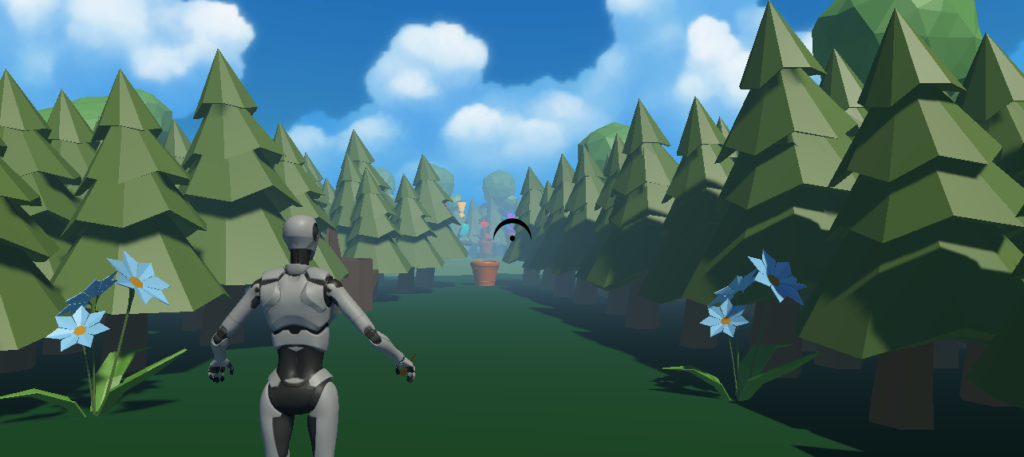
The player sees the puzzle in the distance, the bird with the exclamation point and some flower pots. Helping the player understand that is where they’ll need to go to. The pot will light up when aiming at it, and I hypothesize that as soon as the player can’t move through the pot, they’ll figure out how the click system works.
Iteration:
This week I’ll build the puzzles and the routing. Then I’m going to do a final play test to see if everything works as I intended. If so, Then I’m ready to start the actual test, which I will then start executing.
Final week.
- Player routing
- 5 more puzzles
- Polish
- Test
- Test result
- Conclusion
Make:
Player routing
After reading the article 35 ways to guide the player (Wheeler, 2021), I’ve decided I am going to use pinching, dialogue and a little bit of framing to guide the player from puzzle to puzzle. The set up is linear, finish one puzzle to be able to move on the the next one. There is always one path forward, and one path back. By using corners I can still imbue a sense of discovery when the player turns and suddenly sees the bright colors of a new puzzle.

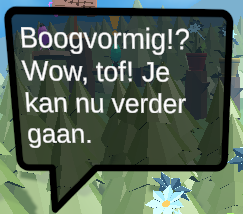
S = start, F = finish, 1 – 6 are the puzzles. There is a corridor going from puzzle to puzzle. When a puzzle is solved, the quest bird shows a piece of dialogue:
And in the starting area the player sees the following, giving them the sense that they’ll need to be able to reach that.
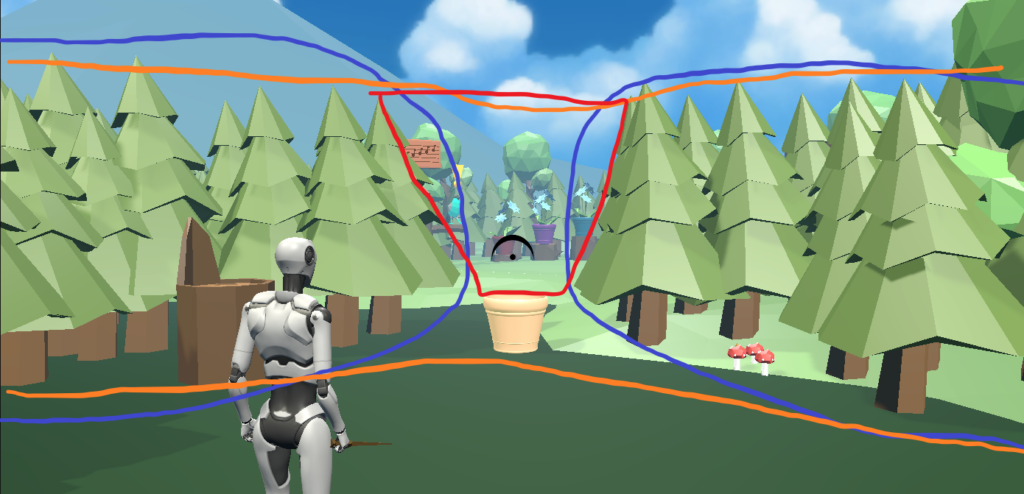
The trees surrounded with blue lines are the foreground blocking and the orange lines show the background blocking. Inside the red trapezium is the puzzle frame, what the player should want to reach.
Puzzles
I already designed the puzzles, so all I had to do was build and implement them.
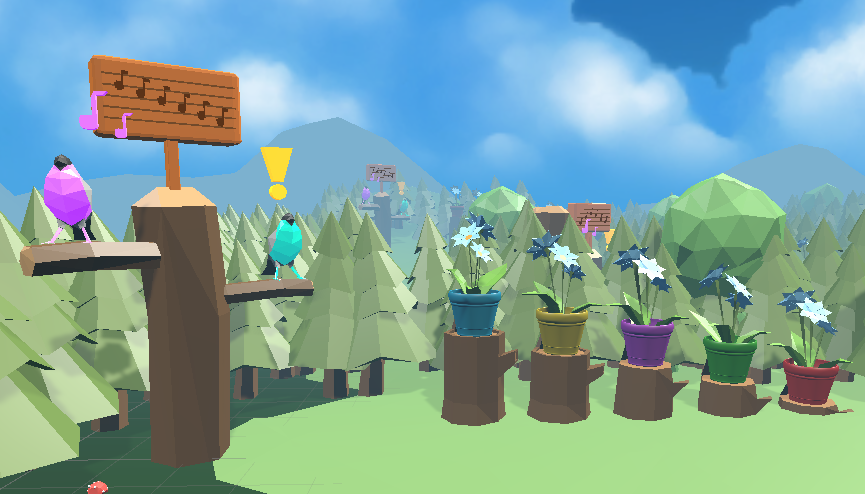
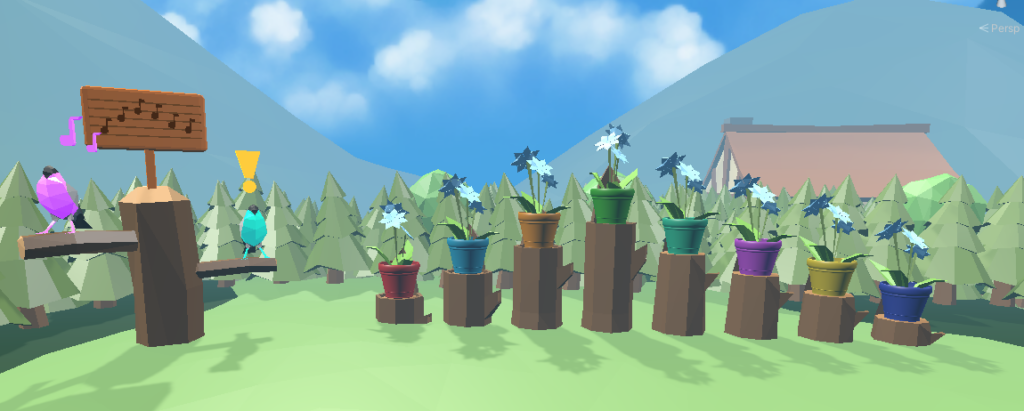
I made some quick images in Aseprite to signal the shape of the melody. I used classic music theory for this.


Final play test
There were a few tactics emerging for solving these puzzles.
- Just go at it.
- One tester was an experienced gamer. After the first two dialogues they stopped checking what the quest bird wanted. They expected it to be the same every time. I accounted for this, so when they finished the puzzle without checking with the bird, the bird dialogue tree skips all the set up and just straight goes to the finished the puzzle dialogue option.
- Listen to the solution bird and from there solve the melodies.
- Some players listened to the entire melody to then listen for specific notes, for instance the third note. They’d save that tone to memory and look for it among the flowers.
- Check the notes one by one against each other.
- This strategy mostly worked for the ascending and descending melodies. They’d click on one flower, and then a second one to find the difference. They’d switch the flowers if necessary and continue until the puzzle was solved.
- Look for extremes
- One tester looked for the extremes of the melodies, i.e. the highest and lowest notes. This helped them with the arching melodies. They listened for the highest note, to place that one at the top. From there they puzzled on.
Polish
I’ve made a few polish choices that lifted the prototype up quite a lot. First I changed the bird’s particle system to hold music notes in stead of the standard shader light points. To simulate the bird starts to sing when the melody is solved.

Then I’ve added some environment objects. I’ve made them very small, and didn’t put them on the highlight layer so after some initial checking, the player should ignore them as possible interactable objects. The play test supported this theory. I saw a tester look at the mushrooms, click a few times, tried to look from a new direction, clicked a few times, then moved on and ignored the mushrooms from then on.


I’ve also added a house model with a little flower garden. This house signifies the start (and finish) of the map, and the flower garden is a way for the player to learn that interacting with flowers plays them a musical note.

As a last visual improvement, I’ve added a burst of particles for when the player finishes the game.

Sound design
I’ve found a nice set of nylon guitar single notes sound files. Using Audacity I’ve compressed the files and set the volume a bit lower. Some notes went on for a long time, about 5 seconds, so I cut those short, trying to make sure the cut-off didn’t sound unnatural. I looked for and found a new background soundtrack, and added a soundtrack of whistling birds for ambiance. I lastly added some win sounds and opening door sounds and a finished the game sound to help gamify the experience.
Test
I decided to take one last proper look at the test. When I told the guild that I had 100 questions prepared, the reactions came down to: “Man, that is a lot”. So I toned it down to 50 questions. I also figured, that to get workable results, I’d need to make the questions harder, and the answers closer to each other. If every tester gets every question right, there is little to test. So I decided on the following. I divided ‘music’ into 5 musical categories:
- Rhythm
- Melody
- Harmony
- Classical theory
- Instruments
I gave each category 10 questions. Then, with the pre- and post test results, I can check if the results of the melody part specifically differ, to then support my hypothesis.
This of course also changed the results table.
| Tester(age) | Rhythm | Melody | Harmony | Theory | Instruments | |||||
| Pre | Post | Pre | Post | Pre | Post | Pre | Post | Pre | Post | |
| #1 | ||||||||||
| #2 | ||||||||||
| #3 | ||||||||||
| #4 | ||||||||||
| #5 | ||||||||||
| #6 | ||||||||||
| #7 | ||||||||||
| #8 | ||||||||||
| #9 |
However the hypothesis still stands. Which is that by playing this game, the player will learn something about musical theory, in this case about melodic contours.
Test method
This experiment will be handled single blindly (Clinical Research Glossary, 2021). I don’t want the testers to know that I’m testing if their knowledge of melodies has increased because that can cause bias. I will ask the tester to sit somewhere comfortable and present them with the questions. I will leave the room to give them a clear mind and when they’ve finished they call me back to the room. I will then put my laptop in front of them. I start the application and tell the player only how the controls work. I then leave the room again to give them room to play the game. When they’re done I get called back again and present them with the same questions. I give them the space to answer the questions once more and then when they’re done I collect the findings. Only then will I tell them what the purpose of the test was, if they’re interested. When I’ve done all the tests I can, i.e. all the people I could muster to do this for me, I collect and analyze the data.
Check:
Test result
| Tester(age) | Rhythm | | Melody | | Harmony | | Theory | | Instruments | |
| | Pre | Post | Pre | Post | Pre | Post | Pre | Post | Pre | Post |
| #1 (58) | 5 | 5 | 8 | 9 | 5 | 4 | 3 | 5 | 8 | 8 |
| #2 (9) | 1 | 4 | 2 | 2 | 1 | 1 | 2 | 2 | 5 | 3 |
| #3 (28) | 9 | 6 | 7 | 9 | 4 | 6 | 6 | 6 | 9 | 8 |
| #4 (26) | 7 | 5 | 8 | 8 | 7 | 8 | 4 | 6 | 5 | 5 |
| #5 (33) | 7 | 9 | 4 | 8 | 5 | 5 | 8 | 8 | 10 | 10 |
| #6 (32) | 8 | 8 | 6 | 8 | 6 | 7 | 5 | 6 | 7 | 8 |
A few interesting things emerged from the test results.
Since the questions were quite difficult, about the level of musical theory that is needed to get accepted to a conservatory, there was some discrepancy between the pre and post tests. For instance tester #3 got 9/10 questions correct on Rhythm on the pre test, but then got 6/10 questions correct on the post test. This could mean that they guessed both times, and simply got a lot more correct the first time, or maybe there was some fatigue and the tester’s mind wasn’t as sharp the second time around.
Tester #2 was a 9-year old. She tried her hardest, but couldn’t get a lot of questions right. She got 2 questions right on Melody on both the pre and post test, however they were different questions. The questions she got right on the post test were questions about melodic contours, as taught in the game, so maybe there is some merit in there.
Tester #1, #3, #5 and #6 got more questions on Melody right on the post than on the pre test. They answered the same questions correctly both times, but added correct answers about melodic contours, exactly as taught in the game. This is an interesting result. After I was finished with tester #3, they asked me what the purpose of the test was. When I explained, they exclaimed: “Well, at least now I know what an arching melody is!”.
Tester #4 had the same amount of questions on Melody right on the pre and post tests. However, the questions differed. They answered one question about intervals wrongly the second time, however they answered a question about melodic contours rightly the second time around, which is promising.
All in all, the results do seem to point towards the testers having learned something about melodic contours.
Conclusion
The hypothesis was: “A person can improve their musical knowledge by playing a musical puzzle game, without actively trying to do so.”
This test was limited. Both in scope and size. However, the final test does show promising results. 4 out of the 6 testers got a significantly higher grade on their post-test, and the other 2 answered questions correctly on the post-test that they answered incorrectly on the pre-test, questions about melodic contours. This quietly suggests that playing video games can improve a persons musical knowledge without actively trying to do so. There are some caveats however. The amount of people I’ve been able to test with is not high, so the result could be happenstance. Also the fact that some testers got discrepancies in their answers in other areas. This could mean that it was more coincidental than I’d hoped. Finally the improvement in knowledge is only tested on the short-term memory. It could very well be that this information fleets from their minds in the coming weeks if it is not reinforced.
All in all I think that the results are interesting. A definitive uptick in results on the Melody part of the post-test questionnaire does suggest that playing video games can help improve knowledge. Further research would be needed to figure out exactly how much of this was subconsciously learned or maybe still consciously learned. In the end, I think that there is merit here, however, if someone wants to use video games to learn actual skills, they should focus more on making gamified applications such as Duolingo.
Bibliography
Bevensee, S. D.-F. (2012). An Exploration of Narrative Understanding of Environmental Storytelling in an Open World Scenario. In D. P. Oyarzun, Interactive Storytelling. Berlin, Heidelberg: Springer, Berlin, Heidelberg.
Blass, L., & Tolnai, C. (2019). Power Up your classroom. USA: ISTE.
Brown, M. (2015, Februari 17). Secrets of Game Feel and Juice. Opgehaald van Youtube: https://www.youtube.com/watch?v=216_5nu4aVQ&t=1s
Camp, M. (2021, Maart 12). Highlight targeted object through Scriptable Render Pipeline [Tutorial][C#] – Unity tutorial 2020. Opgehaald van Youtube.com: https://www.youtube.com/watch?v=XSdBkxxPLYw
Clinical Research Glossary. (2021). Multi-Regional Clinical Trials. Opgehaald van Single Blind Study: https://mrctcenter.org/clinical-research-glossary/glossary-words/single-blind-study/
I-TECH. (2012, Januari). I-TECH Technical Implementation Guide #2. Opgehaald van Guidelines for Pre- and Post- Testing: https://assessmentinaction.files.wordpress.com/2012/08/guidelines.pdf
Rouse, R. (2005). Game Design: Theory and Practice (2nd Edition) (Wordware Game Developers Library). Wordware Publishing inc.
Soegaard, M. (2023, September). Rule of Thirds: The Definitive Guide & Examples. Opgehaald van Interaction Design: https://www.interaction-design.org/literature/article/rule-of-thirds-examples
Unity. (2019, Oktober 23). How to design with feedback and game feel in mind – Unite Copenhagen. Opgehaald van Youtube: https://www.youtube.com/watch?v=yCKI9T3sSv0
Wheeler, J. R. (2021, Maart 10). Game Level Design: 35 Ways to Guide The Player. Opgehaald van Medium: https://jacobryanwheeler.medium.com/game-level-design-35-ways-to-guide-the-player-4bbc324204f4
